1Getting Started 1.1What is IOAI?
1.1.2IOAI Syllabus and Problem Areas
A quick map of the IOAI syllabus, what theory and practice mean, and the main problem areas.
Overview of the IOAI Syllabus
The IOAI syllabus is extremely vast. Open it and you will find a long list. It starts with data and machine learning, then moves into deep learning, computer vision, natural language processing (NLP), and audio. Some topics are algorithms. Others are tools you need to use in code. Some are just theory you need to know. If you are starting from zero, the size of the list can feel intimidating. You do not need to learn all of it at once, but you do need to know how the parts fit together.
Theory and practice
The official syllabus marks topics as Theory, Practice, or Both. Theory means understanding how a method works and why you would use it. Practice means being able to apply it in code and interpret what comes out. Both means you need the explanation and the hands-on skill.
For example, gradient descent is marked Both. You should understand why it changes a model's parameters, and you should be able to use it while training a model. Knowing only the definition will not help much when your training run goes wrong. And not knowing the theory might cost you when you are implementing something and need to remember what the right way of doing it was.
The main problem areas
Here is one way to picture the route through this guide:
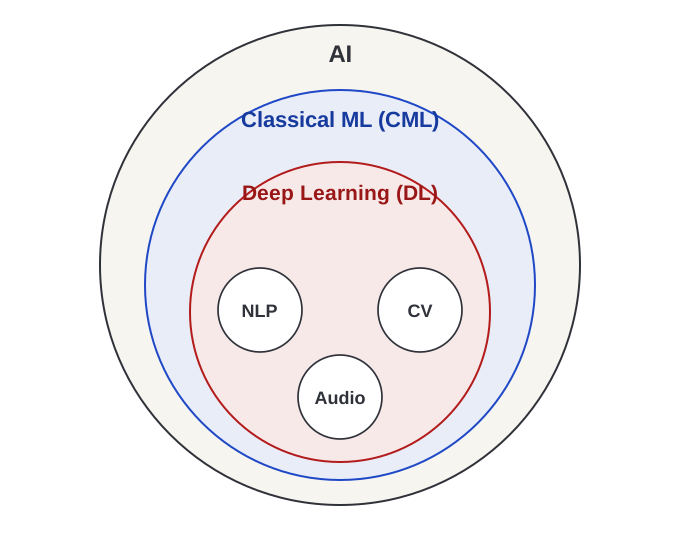
Classical machine learning (CML) gives you methods such as regression, decision trees, and clustering. Deep learning (DL) builds on these ideas, but uses neural networks. NLP deals with language, computer vision (CV) with images, and audio processing with sound. All of these are specific applications of Deep Learning, specifically tuned for a different kind of input. A task may combine these areas, so the three small circles are separate only to keep the map readable.
Why every area matters
IOAI draws tasks from across the syllabus. The 2024 scientific round had one machine learning task, one NLP task, and one vision task. Later contests have mixed areas in different ways, so there is no fixed number of problems per domain. It is safe to assume that each broad domain will feature atleast 1 problem in the actual contest. So preparing for each of the domains is must. You cannot bet on knowing 2 topics and call it a day.
Resources
| Source | Title | Why read it |
|---|---|---|
| IOAI | 2026 Syllabus | The official topics and their theory or practice labels. |
| IOAI | 2024 Tasks | See the machine learning, NLP, and vision tasks from the first IOAI. |
| IOAI | 2026 Individual Contest Tasks | See how later tasks mix several problem areas. |