INAIO Guide Stage 1 1Numerical Foundations
1.3 Absolute values and inequalities
Measure distance without a sign, compare numbers, and solve for every value that satisfies a limit.
Absolute values and inequalities turn descriptions such as “within two units” or “at least five” into mathematics. Absolute value measures the size of a difference, regardless of its sign. An inequality describes a range of acceptable values instead of one exact answer. You will use both when comparing measurements, checking errors, or deciding whether a constraint is met.
This is foundational material. If you can compare negative numbers and solve a simple equation, you can start here. For a first pass, use Khan Academy's lessons on negative numbers and absolute value. The OpenStax section on inequalities adds longer examples and practice.
A basic idea: distance on a number line
The absolute value is the distance from to zero. So and : the two numbers lie on opposite sides of zero but equally far away. More generally, is the distance from to .
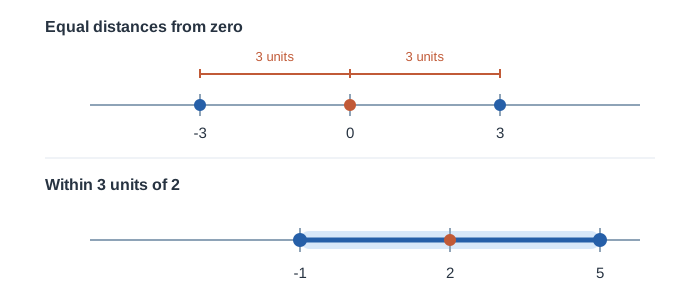
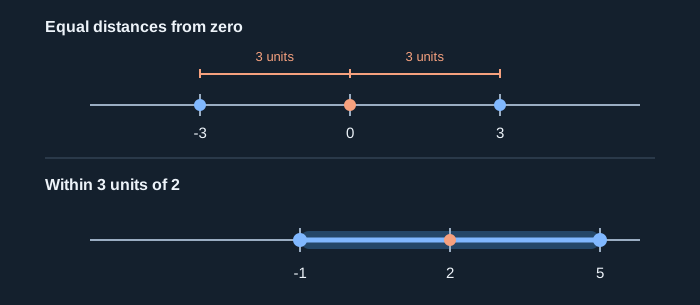
The order on the line also tells you how to compare signed numbers: a number farther right is larger. Thus , even though has the greater absolute value.
A quick tour of rules
Absolute values
The definition is
Absolute value is never negative, and changing a sign does not change a distance: and . The distance between two numbers is . Combining two changes cannot create a greater distance than adding their separate distances, so .
For , two useful translations are
“Within” gives one interval around ; “farther than” gives two regions outside it. A strict sign, or , excludes the boundary. A sign with equality, or , includes it.
Inequalities and numerical comparisons
You can add or subtract the same number on both sides without changing the comparison. Multiplication depends on the sign:
| Starting comparison | Operation | Result |
|---|---|---|
| Add | ||
| Multiply by | ||
| Multiply by |
Multiplying by a negative reverses the order: , but . The same rule applies when you divide by a negative. If the sign of a multiplier is unknown, find it or split into cases before multiplying.
Application 1: a measurement with tolerance
A sensor reports units. Its true reading can be at most units away from the reported value. What readings are possible?
- Write the distance. The difference from is . “At most” includes the limit, so .
- Turn distance into a range. Subtract and add the tolerance: .
- Simplify and check. The range is . Both endpoints are exactly units away; is away and does not qualify.
The sign of an error tells you whether the sensor read high or low. Its absolute value tells you how large the error was.
Application 2: an energy limit
A robot begins with energy units. Each move uses units, and it must keep at least units for its final action. What is the greatest whole number of moves it can make?
- Write the remaining energy. After moves it has units, so the requirement is .
- Solve the inequality. Subtract to get . Divide by and reverse the sign: .
- Use the whole-number constraint. The robot can make at most moves. After moves it has units left; after it has , which fails the requirement.
This question needs both the inequality rule and a comparison between a fractional bound and possible whole-number moves.
Resources
| Source | Title | Why read it |
|---|---|---|
| Khan Academy | Negative numbers and absolute value | Start here for number lines and absolute value practice. |
| OpenStax | Linear and absolute value inequalities | Continue with inequality rules, intervals, and worked problems. |
Finished this module? Mark it done.
Comments
Stuck on something, spotted a mistake, or found a resource that helped you? Tell us below.
Loading comments