INAIO Guide Stage 1 3Functions and Graphs
3.3 Exponential and log functions
Model repeated percentage change with an exponential and use a logarithm to recover its input.
A linear function adds the same amount at each step. An exponential function multiplies by the same factor at each step, so it can describe repeated growth or decay. A logarithm reverses that rule: it tells you how many multiplicative steps are needed to reach a value. This distinction appears in populations, decay, search, and quantities spanning very different scales.
This is intermediate material built on powers and roots, solving equations, and inequalities. Review OpenStax's exponential-functions section first, then its logarithmic-functions section. You should already be comfortable evaluating powers and reading a function graph.
A basic idea: multiply each time
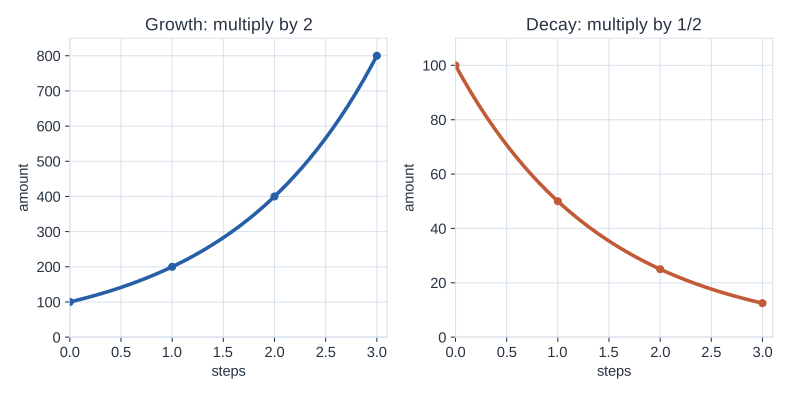
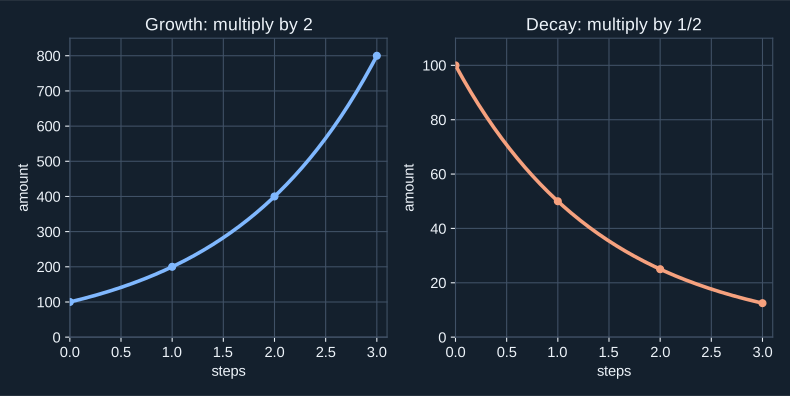
Starting at , multiplying by each step gives . The rule is . Multiplying by instead gives , or . The first graph bends upward; the second approaches zero while staying positive.
A quick tour of formulas
From a repeated change to a rule
The common form is
is the starting amount and is the multiplier per step. A growth rate of per step means : growth uses , so becomes , then . A decay rate of means for : decay uses , so becomes , then . Each percentage acts on the current amount. Adding or subtracting a fixed each step would make a linear rule instead.
| Rule | What stays the same between equal steps | Example from |
|---|---|---|
| Linear: | Difference | |
| Exponential: | Ratio |
Solve for the missing input
For , , and , a logarithm is the exponent that makes :
When an amount is known, isolate the power first, just as Module 2.2 isolates an unknown in an equation:
The target must be positive. For a quick check, becomes . Since , . Taking a logarithm before dividing by would mix the multiplier with the power and obscure the equation.
Read the graph and the allowed inputs
An exponential with accepts every real and gives positive outputs; its graph passes through . If it rises; if it falls towards zero but never reaches zero. The logarithm reverses input and output, so it accepts only positive inputs. For , the points on and on are reflections across . The logarithm grows, but more slowly than the exponential.
When , both and decrease. Therefore, applying to both sides of an inequality reverses its direction, as in Module 2.4. If time is measured in complete rounds, use a whole-number answer and check the rounds just below and above the logarithmic boundary. A continuous answer such as does not mean that three complete rounds are enough.
Application 1: medicine leaving a system
A simplified model says mg of a substance is present initially and half is left after each four-hour period. How much remains after hours?
- Count equal periods. Twelve hours contains four-hour periods.
- Apply the same factor three times. mg.
- Check the sequence. The amounts after , , and hours are , , and mg. Subtracting mg every period would give a different, linear model.
This model describes the repeated fraction, not a fixed loss.
Application 2: yes-or-no questions
A question can have only two answers. In the best case, each question splits the remaining possibilities evenly. With the best choice of questions, what is the minimum number needed to distinguish among possibilities?
- Count possible answer strings. With questions there are at most different sequences of answers.
- Set the requirement. We need , so .
- Use a whole number and check. Nine questions distinguish at most cases; ten distinguish up to . The minimum is .
The logarithm finds a continuous boundary. The question count is a whole number, so the final answer is the ceiling of that boundary.
Resources
| Source | Title | Why read it |
|---|---|---|
| OpenStax | Exponential functions | See growth, decay, and exponential models. |
| OpenStax | Logarithmic functions | Learn the inverse rule and read logarithmic graphs. |
Finished this module? Mark it done.
Comments
Stuck on something, spotted a mistake, or found a resource that helped you? Tell us below.
Loading comments