INAIO Guide Stage 1 1Numerical Foundations
1.2 Powers, roots and logarithms
Use powers, roots, and logarithms to move between a starting number, an exponent, and the result.
Powers and roots are taught early in school because they are basic tools for later mathematics. They belong together: a power builds a result by repeated multiplication, while a root can recover the starting number. A logarithm asks a related question: which exponent produced the result? These three questions appear again in algebra, growth models, and data scales.
For example, the same relationship can be read in three ways:
| Question | Written as | Answer |
|---|---|---|
| What is squared? | ||
| Which positive number squares to ? | ||
| Which power of gives ? |
Powers: repeated multiplication
In , is the base and is the exponent. For a positive whole-number exponent, means multiplying copies of : . The exponent counts the copies; is not .
A quick tour of exponent rules
For the following rules, take and let be real numbers:
| Rule | Formula | Example |
|---|---|---|
| Multiply the same base | ||
| Divide the same base | ||
| Raise a power to a power | ||
| Raise a product to a power | ||
| Raise a quotient to a power | ||
| Use zero or a negative exponent | , |
The base must match before you combine exponents by addition or subtraction. Also, adding two powers is different from multiplying them: , while .
Roots: finding a starting number
If a square has area square units, each side is units long because . This is what tells us.
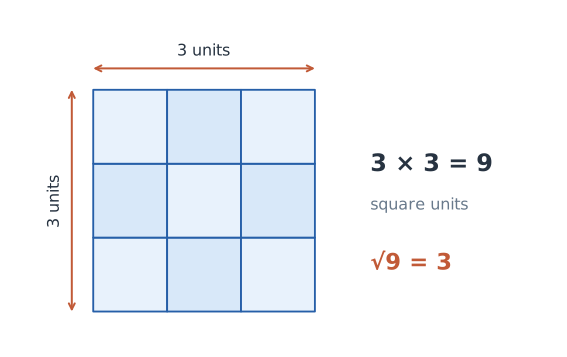
The symbol means the nonnegative square root. So , even though both and equal . If you solve the equation , you must include both solutions, and . More generally, , the distance of from zero (see the next module).
Roots can also be written as fractional exponents. For , a positive whole number and an integer ,
For example, and . A cube root can also take a negative number: . For nonnegative and , ; if , then . The product rule is useful when a square number is hidden inside a larger root, such as .
Logarithms: finding an exponent
Suppose . The unknown is now the exponent. A logarithm names that exponent: . In general,
The base is written as a subscript after . You can check a logarithm by converting it back to a power. For example, because . The notation means a logarithm with base .
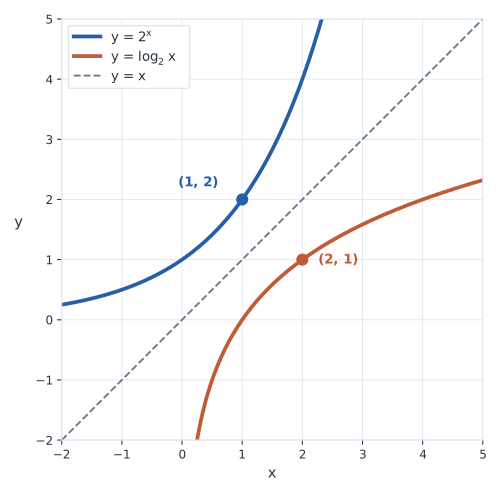
The graph shows the same connection. Every point on becomes the point on . For instance, on the first graph corresponds to on the second.
A quick tour of logarithm rules
For and with :
These follow from the exponent rules: multiplying two powers of adds their exponents. You also have , , , and . To change the base, use . The product rule applies to multiplication, not addition: is generally not .
Application 1: a square that grows
A square has area square centimetres. Its side length is doubled. What is the original side length, and what is the new area?
- Recover the side from the area. A side squared gives the area, so the original side is cm.
- Double the side. The new side is cm.
- Square the new side. The new area is square centimetres.
Check it another way: doubling both dimensions makes the area times as large. The original area was , and . A root found the missing length; exponent rules made the new area quick to calculate.
Application 2: how many doublings?
A dataset starts with records and doubles after every round. After how many complete rounds will it first contain at least records?
- Write the growth rule. After rounds, the dataset has records. We need .
- Isolate the power. Divide by : .
- Find the exponent. Since base is greater than , taking keeps the inequality's direction: . The first whole number that works is .
- Check the boundary. After rounds there are records, still below . After rounds there are .
Here the logarithm answers an exponent question, while the final check turns that continuous answer into a number of complete rounds.
Resources
| Source | Title | Why read it |
|---|---|---|
| OpenStax | Exponents and scientific notation | Review exponent rules with worked examples and exercises. |
| OpenStax | Radicals and rational exponents | Connect roots to fractional powers. |
| OpenStax | Logarithmic functions | Learn how logarithms reverse exponential relationships. |
Finished this module? Mark it done.
Comments
Stuck on something, spotted a mistake, or found a resource that helped you? Tell us below.
Loading comments