INAIO Guide Stage 1 3Functions and Graphs
3.4 Trigonometry and periodicity
Recognise repeating behaviour, read amplitude and period from a sine curve, and reason through a cycle.
Some quantities repeat: a rotating wheel returns to the same position, tides rise and fall, and a timed signal restarts its cycle. Periodic means that the same pattern recurs after a fixed interval. Sine and cosine are smooth periodic functions, useful when the change between repeats is gradual. Other periodic rules may switch abruptly.
This is intermediate work. You need to read graphs and know that a full turn is radians, or . OpenStax's sine-and-cosine graphs build the visual picture. For Stage 1-style reasoning, recognising the cycle and its units is often more important than memorising many identities.
A basic idea: the graph repeats
The sine function starts at , reaches at , returns to at , reaches at , and returns to at . Then the same sequence starts again:
The number is a period: shifting the input by it leaves the output unchanged. Cosine follows the same wave shape but starts at instead of .
A quick tour of formulas
A common model is
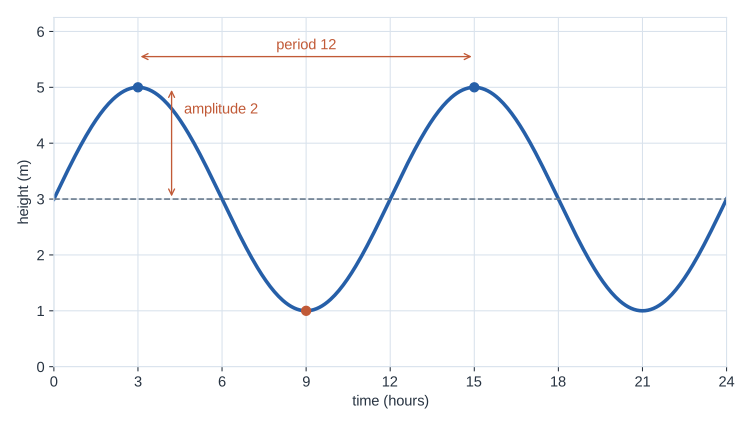
is the midline or average level, is the amplitude, shifts the pattern right by , and the period is when . The highest and lowest values are and . A cosine model has the same parameters and a different starting point.
Check whether an angle is given in degrees or radians before evaluating a trig function. A period such as hours uses radians per hour. If a question uses whole cycles rather than angles, the remainder after dividing by the period locates a time inside one cycle.
Not every periodic function is a sine wave. A traffic light is periodic but switches states rather than moving smoothly. Choose the shape that matches the situation.
Application 1: reading a tide model
A simplified tide height, in metres, is , where is hours after midnight. What are its range and period, and what heights occur at and ?
- Read the centre and amplitude. The midline is m and the amplitude is m, so the height ranges from m to m.
- Find the repeat time. The angular coefficient is , so hours.
- Evaluate the two times. At , the angle is and m. At , the angle is and m.
The two times are six hours apart, half a period, so a peak and a trough are consistent.
Application 2: a repeating signal
A signal restarts every seconds. It is on for the first seconds of each cycle and off for the rest. Is it on at seconds, and when will it next turn on?
- Locate the current cycle. Two complete cycles take seconds. The remainder is seconds.
- Compare with the on-window. is not in the first seconds, so the signal is off.
- Find the next restart. The next cycle begins at seconds, which is seconds later.
This signal is periodic even though its graph has flat sections and sudden jumps. The period alone does not tell you the shape within a cycle.
Resources
| Source | Title | Why read it |
|---|---|---|
| OpenStax | Graphs of sine and cosine | Study amplitude, period, phase shifts, and worked graphs. |
Finished this module? Mark it done.
Comments
Stuck on something, spotted a mistake, or found a resource that helped you? Tell us below.
Loading comments