INAIO Guide Stage 1 9Random Variables and Expected Value
9.1 Discrete random variables
Turn outcomes into numbers, build a discrete probability distribution, and check that its probabilities sum to one.
A random experiment produces an outcome; a random variable turns that outcome into a number you can study. It might count successes, record a cost, or give a score. This is the bridge from basic probability to expected value.
This is foundational to intermediate probability. Begin with OpenStax's discrete-distribution lesson. You should know sample spaces and event probabilities first.
A basic idea: one number for each outcome
Let be the number of heads in two fair tosses. The four equally likely outcomes are , and assigns them . Several outcomes can produce the same value. The distribution gathers their probabilities.
| Value | |||
|---|---|---|---|
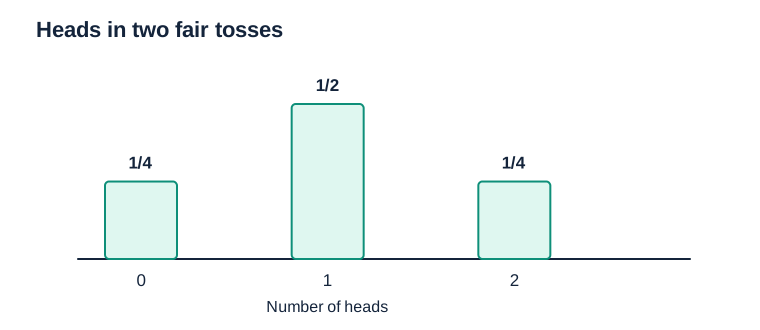
A quick tour of properties
For a discrete variable , its probability mass function is . Every value has , and the probabilities over all possible values add to . To find , add the probabilities at values at least . A count always takes nonnegative integer values; a payoff can be negative.
Application 1: count heads
What is the chance of at least one head in two fair tosses?
- The table gives and .
- These possible values cannot occur together, so add them.
- .
Application 2: a small reward game
A machine gives points for a red token, points for blue, and no reward for green. Their probabilities are , , and . Let be the reward.
| Reward | |||
|---|---|---|---|
The probabilities sum to . The chance of a reward of at least is . The distribution is about rewards, so its values are , not the colour names.
Resources
| Source | Title | Why read it |
|---|---|---|
| OpenStax | Discrete random variables | Learn to tabulate values and their probabilities. |
Finished this module? Mark it done.
Comments
Stuck on something, spotted a mistake, or found a resource that helped you? Tell us below.
Loading comments