INAIO Guide Stage 1 8Probability
8.1 Sample spaces and events
Understand probability as a measure of chance, then identify the outcomes and events whose chances a question asks for.
Probability is a number that describes how likely something is to happen under stated conditions. A probability of means it cannot happen; means it is certain. Values between them describe uncertainty. For example, the probability of heads on one fair coin toss is . That does not promise a head on every second toss. It says that, over many tosses under the same conditions, heads should occur about half the time.
To give such a number, we must first be clear about what is happening and what result we care about. If we roll a die, are we asking for a particular face, an even number, or a number greater than ? Each question selects different results from the same roll. This is why probability begins by naming the possible results and the event whose chance we want.
This is foundational probability, used throughout the later probability and expected-value modules. OpenStax's introduction to probability terminology is a place to learn it; you only need fractions and basic counting.
A basic idea: from a roll to a chance
Imagine rolling a fair six-sided die once. The roll is an uncertain experiment. One result, such as , is an outcome. To make sure we have not missed a result, collect all six possible outcomes into the sample space .
Now ask for the chance of an even result. That question picks the outcomes ; together they form the event . The notation means the probability of that event. Because this die is fair, each face has chance , so . The event is a part of the sample space, and its probability gathers the chances of the outcomes in that part.
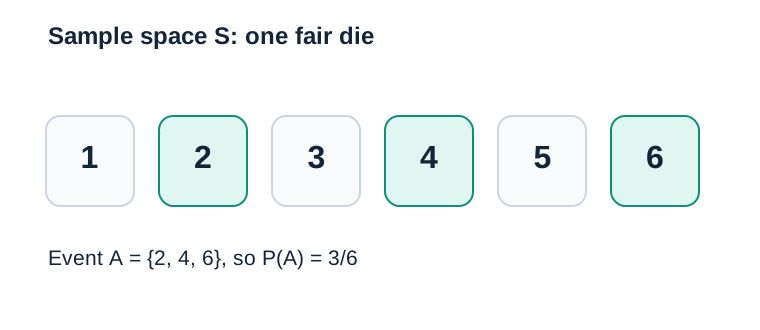
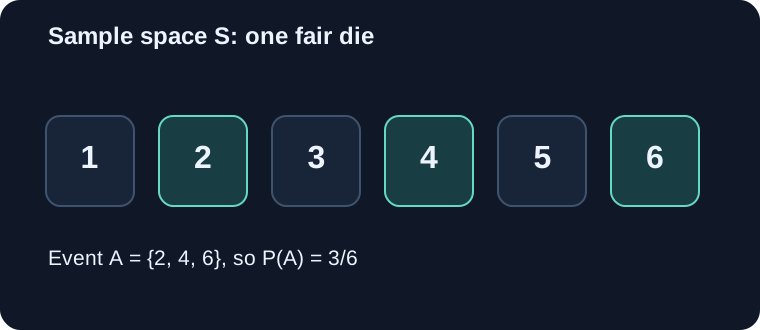
The fair die lets us count faces because its six outcomes are equally likely. Equal counting is a special case, not the meaning of probability itself. For a spinner with unequal regions, two colours may have different chances; we must add their actual probabilities instead of just counting colours.
A quick tour of formal definitions
| Term | Formal meaning | Die-roll example |
|---|---|---|
| Experiment | A process with an uncertain result | Roll once |
| Outcome | One possible complete result | |
| Sample space | The set of all possible outcomes | |
| Event | A subset of ; the outcomes that meet a stated condition | Even: |
| Probability | A number assigned to event , between and |
For the whole space, ; for the empty event, . For a finite sample space, add the chances of the individual outcomes in an event. If all outcomes in are equally likely, this becomes
The complement contains outcomes outside , so . The union contains outcomes in or ; the intersection contains outcomes in both. If , the events are disjoint and . Module 8.5 handles overlapping events.
Application 1: one fair die
What is the probability of rolling an even number or a ?
- The sample space is .
- The event is . All six faces are equally likely.
- Thus .
You could also add and because those events cannot happen together.
Application 2: an unequal spinner
A spinner lands on red, blue, or green with probabilities , , and . What is the probability of not landing on red?
- The sample space is and the event is .
- The two outcomes in are not equally likely, so add their chances: .
- Check with the complement: is “not red,” so .
Counting “two of three colours” would incorrectly give . First check whether equal counting is justified.
Resources
| Source | Title | Why read it |
|---|---|---|
| OpenStax | Probability terminology | Start with outcomes, sample spaces, and events. |
Finished this module? Mark it done.
Comments
Stuck on something, spotted a mistake, or found a resource that helped you? Tell us below.
Loading comments