INAIO Guide Stage 1 10Coordinate Geometry and Vectors
10.3 Vectors and vector operations
Represent displacements as vectors and combine them through addition, subtraction, scaling, and length.
A point says where something is; a vector says how far and in which direction it moves. Vector notation also packages several features into one object, making it useful in geometry, physics, and machine learning.
This is intermediate geometry. OpenStax's vector lesson starts with drawings and components. Review coordinates before continuing.
A basic idea: directed displacement
The vector from to is . A vector can be drawn elsewhere without changing its components: only its length and direction matter.
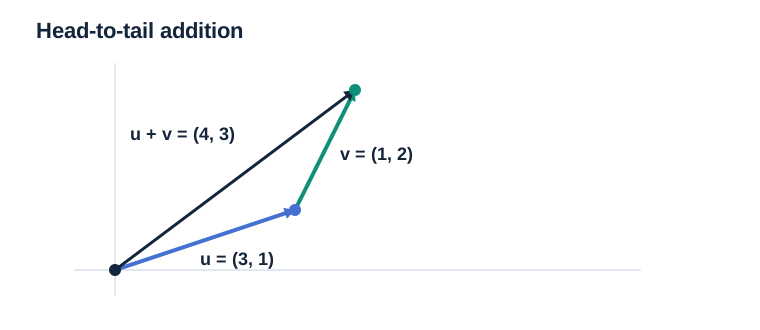
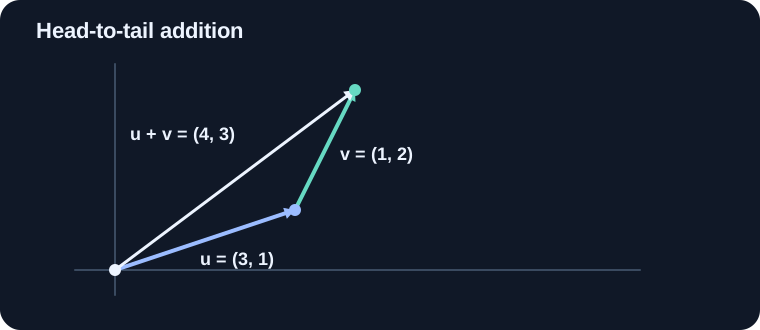
A quick tour of operations
For and ,
The length or norm is . The zero vector has length zero. Multiplying by a negative scalar reverses direction; adding vectors head to tail gives the net movement.
Application 1: two robot moves
A robot moves , then from the origin.
- Add components: .
- Its final position is and its net displacement length is .
- The distance it actually travelled along the two straight moves is , which is longer than the net displacement .
Application 2: feature changes
A point has features and is updated to . The change vector is . It means the first feature fell by and the second rose by ; its norm is . Subtraction tells you the change even when the coordinates do not represent physical movement.
Resources
| Source | Title | Why read it |
|---|---|---|
| OpenStax | Vectors | Learn components, magnitude, and vector operations. |
Finished this module? Mark it done.
Comments
Stuck on something, spotted a mistake, or found a resource that helped you? Tell us below.
Loading comments