INAIO Guide Stage 1 7Combinatorics and Discrete Reasoning
7.1 Counting principles
Count choices in stages, add separate cases, and use complements when direct counting is awkward.
Counting is the first step in many probability and discrete-reasoning problems. The challenge is rarely counting to a large number by hand. It is deciding which choices form separate cases, which happen in sequence, and whether the same outcome has been counted twice.
This is foundational to intermediate work. OpenStax's counting-principles section develops the rules with examples. You only need arithmetic to begin, but careful wording matters.
A basic idea: “or” and “then”
If you can choose one of blue badges or one of red badges, there are choices. If you then choose one of shirts, each badge choice can pair with every shirt: outfits. The first decision joins separate cases; the second pairs every badge with every shirt.
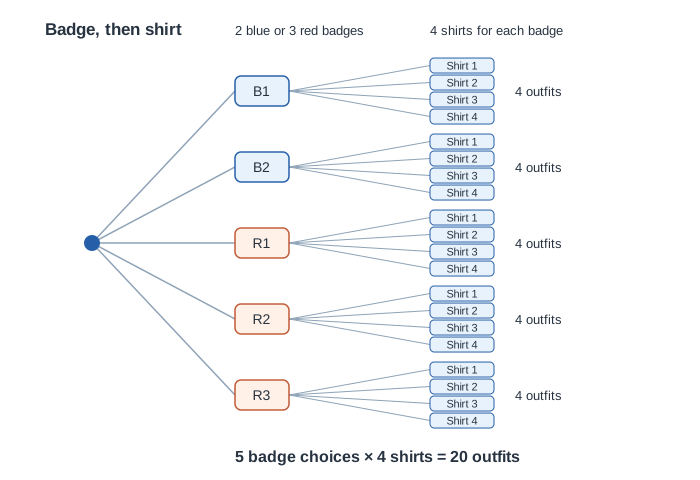
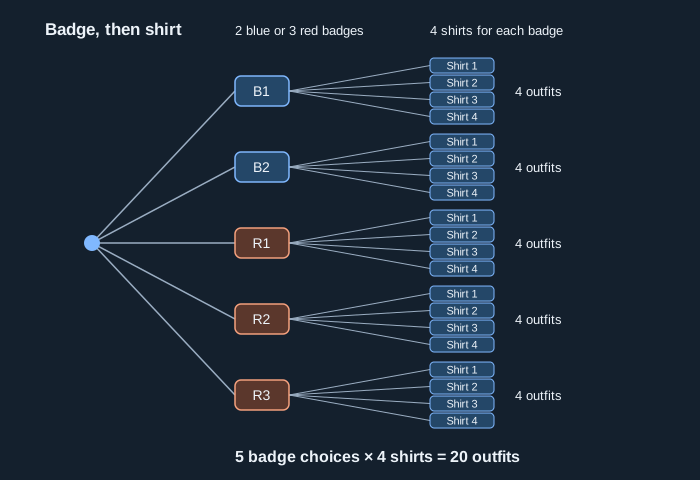
A quick tour of counting rules
Count by addition when one outcome comes from one of several separate cases. If case has outcomes and case has , then there are outcomes in “ or ,” provided the cases are disjoint: no outcome belongs to both. For example, choosing one of blue badges or one of red badges gives badge choices. If cases overlap, subtract the overlap rather than counting it twice.
Use the fundamental rule of multiplication when a complete outcome requires a choice at every stage. If stage has choices, stage has choices after each first choice, and so on, then
This is also called the fundamental counting principle. Use it when every combination of stage choices is allowed and counted once, with the stated number of options available at each stage. Choosing one of badges and then one of shirts gives outfits. Four positions with options each give strings: a repeated application of the same rule.
| What the question asks you to count | Rule to use | Small example |
|---|---|---|
| One outcome from disjoint alternatives | Add their counts | Blue or red badge: |
| One choice at each stage | Multiply the stage counts | Badge and shirt: |
| Different numbers of later choices in different cases | Multiply within each case, then add | mains with sides or mains with sides: |
| An unwanted set is easier to count | Subtract it from the total | All strings strings with no “yes” |
Do not decide from the words “or” and “and” alone. Check that separate cases do not overlap and that every stage combination is valid. If later choices vary with an earlier choice, draw a short tree and add the counts at its final branches instead of using one fixed product.
Before calculating, define what makes two outcomes different. If order changes the outcome, count ordered sequences; if it does not, a later module's combinations rule will remove duplicate orderings.
Application 1: assembling a menu
A meal has one main dish, either one of vegetarian dishes or one of other dishes. Vegetarian mains come with a choice of sides; the others come with a choice of sides. How many different meals are possible?
- Split by main-dish type. The cases do not overlap, and the number of sides depends on the case, so a single product will not work.
- Multiply inside each case. Vegetarian: . Other: .
- Add the cases. meals.
Multiplying would overcount: it gives every other main four sides when only three are available.
Application 2: at least one positive flag
Four separate checks each produce either “yes” or “no.” How many four-answer strings contain at least one “yes”?
- Count every string. Each of the four positions has options, giving strings.
- Count the complement. Exactly one string has no “yes”: no, no, no, no.
- Subtract. The answer is .
Directly counting strings with exactly one, two, three, and four “yes” answers also works, but the complement is shorter. No probability assumption is needed here: we are counting possible strings, not how likely they are.
Resources
| Source | Title | Why read it |
|---|---|---|
| OpenStax | Counting principles | Start with addition and multiplication rules, then practise casework. |
Finished this module? Mark it done.
Comments
Stuck on something, spotted a mistake, or found a resource that helped you? Tell us below.
Loading comments