INAIO Guide Stage 1 11Matrices and Linear Transformations
11.5 Transition matrices
Put step-by-step movement between states into one matrix, then update counts or probabilities without mixing old and new values.
In Module 4.5, we tracked what stayed in each group and what moved to another group. In Module 11.3, a matrix combined several old inputs into new outputs. A transition matrix puts these ideas together: one row records all the destinations possible from one current state. Multiplication then applies the same movement rule to an entire population or probability distribution at once.
This is intermediate matrix and probability work. Review the two-state model in Module 4.5 and the matrix product first. MIT's Markov-chain notes go much further; the finite two-state calculations here are enough to begin.
A basic idea: stays plus arrivals in one calculation
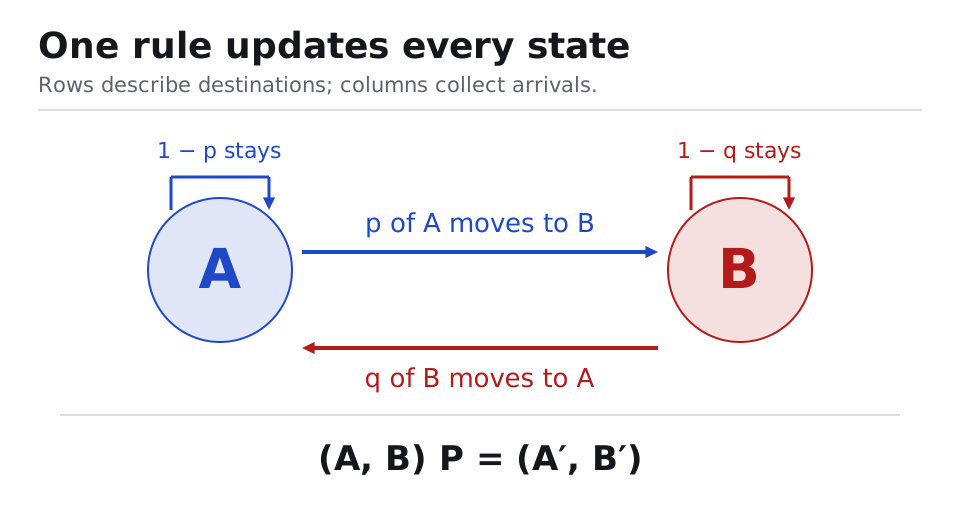
Suppose each period, fraction of group moves to , and fraction of moves to . The rest stay. Put the old counts into a row and the movement fractions into
The first row lists where someone in goes; the second lists where someone in goes. Now says
These are exactly the stays plus arrivals equations from Module 4.5, now packaged in one matrix product. Both new entries are computed from the same old row.
A quick tour of transition rules
For states , is the fraction or probability of moving from state to state in one step. Every entry is nonnegative, and each row sums to when everyone has one destination among the listed states. With a row-vector state, and . Entry adds the probabilities of all two-step routes from to through an intermediate state.
If lists probabilities, its entries sum to and is the next distribution. If it lists counts, the same formula gives expected counts when transitions are random, or exact counts when the stated fractions move exactly as described. A fixed transition rule says the next move depends on the current state; when this is used as a probabilistic model, it is a simple Markov chain.
The earlier matrix–vector lesson used column vectors . If you prefer that convention, let and write . Transpose the matrix as well as the vector; otherwise the directions of movement change. Module 11.6 explains the corresponding row and column sums. Later, random walks on graphs use the same row-vector update to track a walker's location probabilities.
Application 1: two groups of people
Initially people are in and in . Each period, of moves to and of moves to . Find the next counts.
- The row transition matrix is .
- .
- The total is still : everyone either stayed or moved between the two listed groups.
Application 2: changing weather
Suppose a sunny day is followed by sun with probability and rain with ; after rain, the next day is sunny with and rainy with . Starting with a certainly sunny day, what is the weather distribution after two updates?
- In the order (sun, rain), and .
- After one update, .
- Use the new distribution for the second update: .
Resources
| Source | Title | Why read it |
|---|---|---|
| MIT OpenCourseWare | Finite-State Markov Chains | Study transition probabilities and repeated matrix updates after the two-state examples. |
| OpenStax | Matrices and matrix operations | Review the matrix multiplication used in each update. |
Finished this module? Mark it done.
Comments
Stuck on something, spotted a mistake, or found a resource that helped you? Tell us below.
Loading comments