INAIO Guide Stage 1 9Random Variables and Expected Value
9.3 Linearity of expectation
Add expectations directly, even for dependent variables, and use indicators to count events.
Sometimes the full distribution of a total is difficult to find, but the average contribution of each part is easy. Linearity of expectation lets you add those contributions. It is especially useful for counts of many events that overlap or depend on one another.
This is intermediate probability. Review expectation in Module 9.2, then see MIT OpenCourseWare's lecture notes on indicators and linearity.
A basic idea: add the parts
For random variables with finite expectations,
The variables do not need to be independent. This is a statement about averages, not a claim that their probabilities multiply. If a total is a count, let be when event happens and otherwise. Then and
A quick tour of properties
Constants also pass through sums: . Linearity works for any finite number of terms with finite expectations. It does not say without further conditions.
Application 1: matching cards
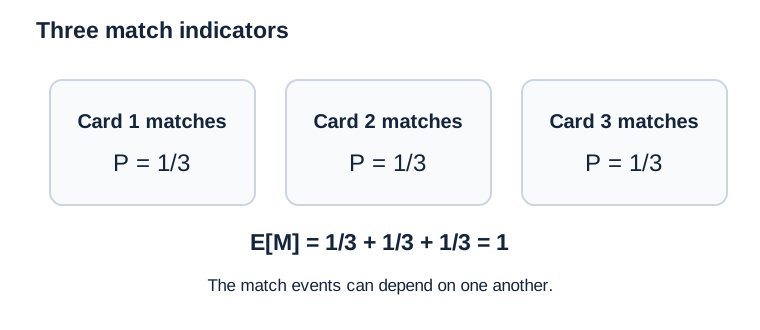
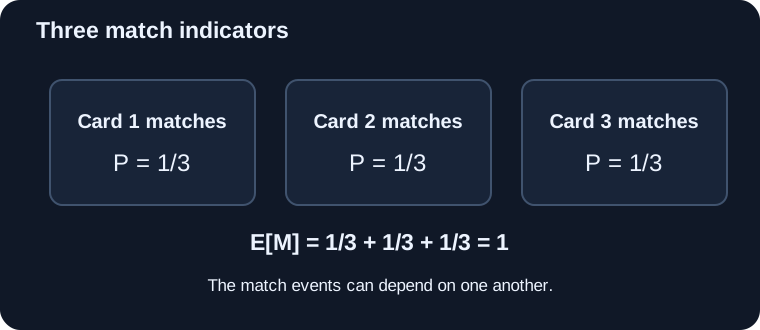
Three distinct cards are placed at random, one per envelope, into three matching labelled envelopes. Let if card lands in its matching envelope. How many matches are expected?
- Each card has probability of matching its own envelope.
- The total matches are .
- match.
The match events are dependent: matching two cards forces the third. Linearity still works.
Application 2: two dependent costs
Rain has probability . Transport costs on a dry day and on a rainy day; on rainy days you also pay for shelter. Let be the transport cost and the shelter cost. Both depend on the weather, so they are dependent. Still,
Check directly: the total is or , and .
Resources
| Source | Title | Why read it |
|---|---|---|
| MIT OpenCourseWare | Lecture 22: Expectation | See indicator variables and linearity applied to counts. |
Finished this module? Mark it done.
Comments
Stuck on something, spotted a mistake, or found a resource that helped you? Tell us below.
Loading comments