INAIO Guide Stage 1 5Calculus and Optimisation
5.1 Basic differentiation
See why a curve needs a local slope, then use differentiation to find its instantaneous rate of change.
A straight line has one slope: each equal step to the right changes its height by the same amount. A curve does not. Its steepness can change as we move along it, so one slope for the whole graph cannot tell us what is happening at a particular point. Differentiation finds that local slope. It answers questions such as how fast an object is moving now, how a small change in production affects cost, and where a graph changes direction. Those local changes are also the starting point for optimization.
This is intermediate mathematics. Review the slopes of linear and quadratic functions and be comfortable with powers and algebra first. OpenStax's derivative introduction explains secant and tangent slopes; its differentiation rules give calculation practice.
A basic idea: from an average slope to a local slope
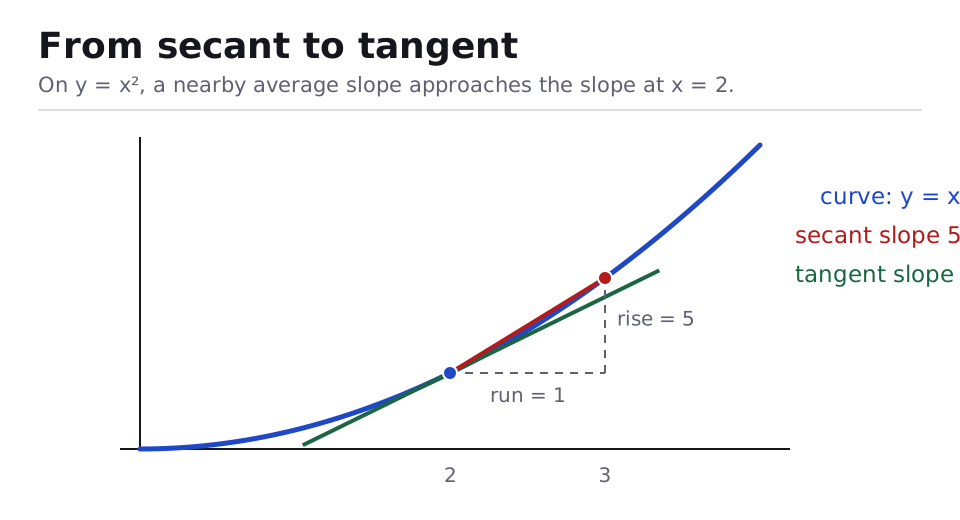
Slope means vertical change divided by horizontal change, often called rise over run. For a curve, choose two points and draw the line through them. This secant line measures the curve's average slope between those points. For , the graph goes from to : the rise is , the run is , and the average slope is .
To find the slope at , bring the second point closer. From to , the average slope is . From to , it is . The slopes approach . The secant line approaches the tangent line, which follows the curve's direction at ; its slope there is .
The algebra shows why. Write the second input as , where is a nonzero horizontal step:
We do not divide by zero. We look at what approaches as the step approaches zero: , whether the second point comes from the left or the right. This is the derivative at , written . At a sharp corner, slopes approaching from the two sides can disagree, so there may be no derivative. Repeating the calculation at a general input gives , so . At , the curve is steeper: its tangent slope is .
The derivative is useful for small-change estimates too. Near , a step of raises by about . The actual rise is ; the tangent gives a close local estimate, not the exact change over a whole interval.
A quick tour of rules
The definition is when that limit exists. You usually calculate with rules instead of repeating the limit:
| Function | Derivative | Small example |
|---|---|---|
| Constant | ||
| Product | ||
| Quotient | Only where | |
| Composition |
The last line is the chain rule: differentiate the outside, then multiply by the inside's derivative. The product rule is not just , and the quotient rule is not . Check by expanding a simple expression when possible.
A positive derivative means the graph is rising locally, and a negative one means it is falling locally. A zero derivative marks a flat tangent, but it need not be a maximum or minimum: has derivative at and keeps rising. A sharp corner such as has no derivative at its corner. If the input is time and the output is metres, the derivative has units metres per unit of time.
Application 1: speed at an instant
A position model is metres for seconds. What is the instantaneous speed at ?
- Differentiate. metres per second.
- Evaluate. metres per second.
- Compare with an interval. From to seconds, position changes from to metres, an average of metres per second. The instant at is slower because this model's speed is increasing.
Application 2: cost near ten units
A simplified cost model is units for quantity . Estimate the extra cost of one more unit near .
- Differentiate. cost units per item.
- Evaluate the local rate. , so a small increase near costs about units per item.
- Check a whole-item step. units. The derivative gives a local approximation; the exact one-item change is slightly larger because the curve rises.
Resources
| Source | Title | Why read it |
|---|---|---|
| OpenStax | Defining the derivative | Start with secant and tangent slopes. |
| OpenStax | Differentiation rules | Practise the constant, power, sum, product, and quotient rules. |
Finished this module? Mark it done.
Comments
Stuck on something, spotted a mistake, or found a resource that helped you? Tell us below.
Loading comments