INAIO Guide Stage 1 9Random Variables and Expected Value
9.2 Expected value
Compute expected value as a probability-weighted average and interpret it in the units of the outcome.
When outcomes differ, an ordinary average gives each outcome equal weight. Expected value weights each outcome by how likely it is. This lets you compare games, costs, and decisions that may have different outcomes each time.
This is intermediate probability. Work through OpenStax's expected-value examples after learning discrete distributions. The calculation extends the weighted averages and finite sums from Module 1.4: probability supplies each outcome's weight.
A basic idea: weight each possible result
If takes values with probabilities , its expectation is
The probabilities must add to one. Expected value has the same units as : rupees for a payoff, minutes for travel time. It describes a long-run average under repeated comparable trials; it need not be a value that can occur in one trial.
A quick tour of properties
Adding a fixed amount to every outcome adds to the expectation: . Scaling every outcome by gives . For a cost and reward , define net payoff before calculating. Keeping gross and net values separate avoids a common error.
Application 1: a paid game
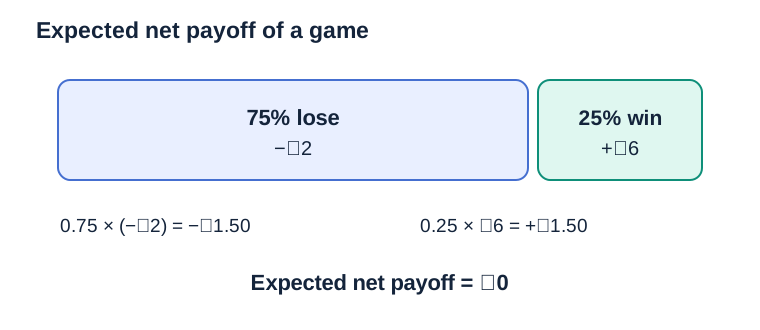
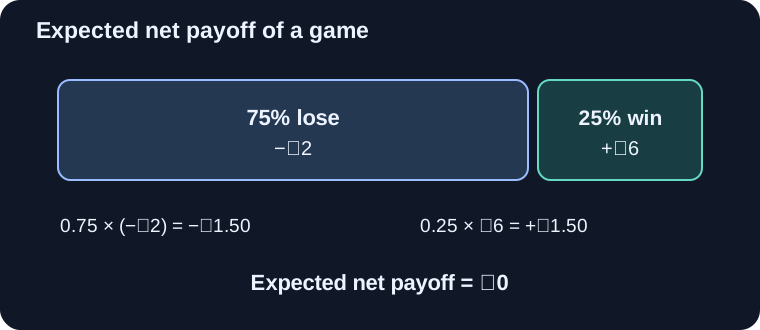
A game costs ₹. With probability it pays ₹; otherwise it pays nothing. What is the expected net payoff?
- A win nets rupees; a loss nets rupees.
- rupees.
- Equivalently, expected reward is rupees, then subtract the ₹ fee.
A zero expectation does not mean every play pays zero.
Application 2: travel time
A route takes minutes on a clear day with probability and minutes in congestion with probability . Its expected travel time is
No actual trip lasts 29 minutes in this two-outcome model. The number is useful for comparing this route with alternatives over many trips.
Resources
| Source | Title | Why read it |
|---|---|---|
| OpenStax | Mean or expected value and standard deviation | Practise probability-weighted averages. |
Finished this module? Mark it done.
Comments
Stuck on something, spotted a mistake, or found a resource that helped you? Tell us below.
Loading comments