INAIO Guide Stage 1 1Numerical Foundations
1.4 Averages and summations
Summarise a group fairly by tracking its weights, and write finite sums without losing any terms.
An average compresses several values into one representative number. A finite sum adds a specified list of terms, often before an average is taken. These ideas appear in scores, data summaries, expected outcomes, and repeated processes. The arithmetic is usually easy; the important decision is what each value represents and how often it occurs.
This is foundational to intermediate work. Start with OpenStax's explanation of means if averages are new. Its section on series notation covers the sigma symbol and finite sums. You only need basic arithmetic to begin; the notation is the newer part.
A basic idea: every value has a count
The mean of , , and is . We add the three values and divide by the number of values. If a value appears more than once, it contributes more than once. For example, the mean of , , and is , not .
We can record repeated values with weights. The values and have weights and , so their weighted mean is . A weight can be a count, a share, or a stated importance. Its meaning determines the denominator.
A quick tour of formulas
For values , the ordinary mean is
The symbol means “add the terms.” The index starts at and ends at . For example, . Always write the first and last terms when the index is unfamiliar.
For nonnegative weights with a positive total, the weighted mean is
If the weights already add to , the denominator is . If they are group sizes, divide by the total group size. Two sum rules often save work:
For an arithmetic list with equally spaced terms, its sum is . Check that you know how many terms there are before using it.
Application 1: combining two groups
Four students have an average score of , while six students have an average score of . What is the average across all ten students?
- Recover each group total. The first group contributes points; the second contributes .
- Combine totals and counts. The ten students have points, so their mean is .
- Check the weight. The result is closer to than to because the lower-scoring group has more students. Averaging the two group means to get would incorrectly give the groups equal weight.
The same method works when each group's size and mean are known but its individual values are not.
Application 2: counting a growing tile pattern
A pattern has five rows containing , , , , and tiles. How many tiles are there altogether?
- Write the terms. Row has tiles for .
- Expand the sum. .
- Check the shape. The odd-sized layers can be fitted around one another to make a by square, so the total should be .
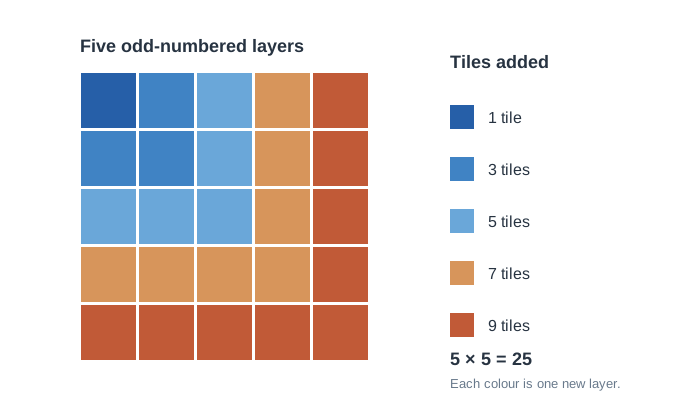
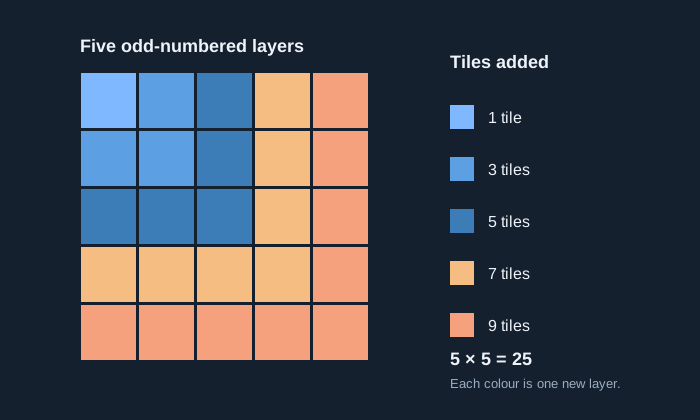
The picture also suggests the general rule . A finite sum can describe a list, while a visual pattern can explain why its answer has that form.
Resources
| Source | Title | Why read it |
|---|---|---|
| OpenStax | Measures of the center of data | Learn means and frequency-weighted averages from data tables. |
| OpenStax | Series and their notations | Practise expanding and evaluating sigma notation. |
Finished this module? Mark it done.
Comments
Stuck on something, spotted a mistake, or found a resource that helped you? Tell us below.
Loading comments