INAIO Guide Stage 1 7Combinatorics and Discrete Reasoning
7.3 Counting with restrictions
Count only the arrangements that obey a condition, using blocks, complementary counts, or disjoint cases.
The counting rule in Module 7.1 and the permutation formula in Module 7.2 count arrangements when choices are freely available. A restriction changes the problem: perhaps two objects must stay together, the first digit cannot be zero, or the last digit must be even. We need to count valid outcomes, without including forbidden ones or counting any valid one twice.
This is intermediate combinatorics. Start with OpenStax's restricted selection examples; MIT's counting notes provide further practice. First decide what makes two arrangements different, then describe the restriction in those terms.
A basic idea: build only what is allowed
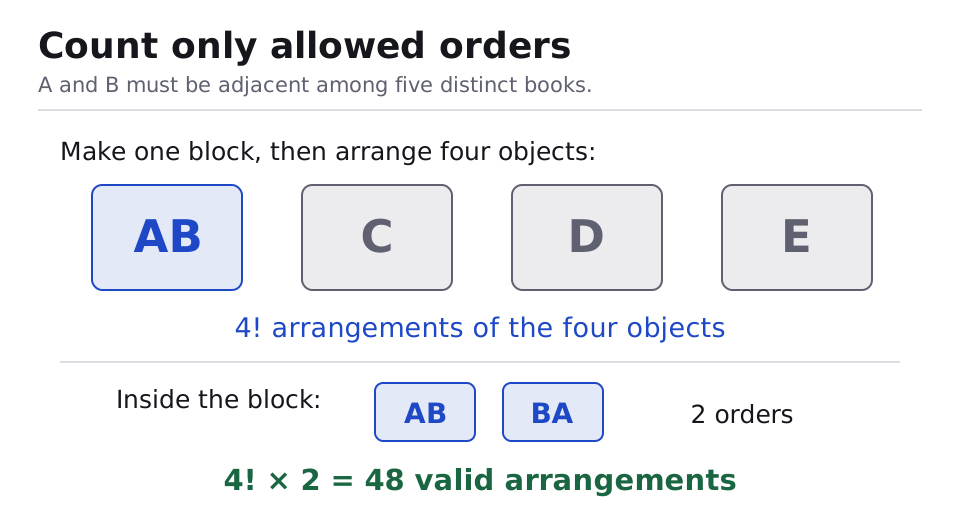
Suppose five distinct books include and , which must be adjacent on a shelf. Treat and temporarily as one block. We now arrange four objects: the block and the other three books. That gives orders. Inside the block, and can appear as or , so the valid total is .
A quick tour of methods
Make a block when specified objects must be together. Count their internal orders separately. This works only when the block really occupies consecutive positions.
Split into disjoint cases when a restriction changes later choices. For an even last digit, the cases “last digit is ” and “last digit is ” do not overlap; multiply within each case, then add. A single product would be wrong if the first-digit choices differ between those cases.
Use the complement when forbidden arrangements are easier to count: valid all forbidden. If there are several forbidden conditions that overlap, subtracting each separately can remove some outcomes twice. Use the overlap rule from Module 8.5 or make disjoint cases instead.
There is no formula that replaces this setup step. Before doing arithmetic, state what each case counts and why every valid outcome belongs to exactly one case.
Application 1: adjacent books
Five distinct books are arranged on a shelf. How many orders have and together?
- Replace by one block. The block, , , and can be arranged in ways.
- Within the block, choose or : ways.
- Multiply to get . Each shelf order gives one block position and one internal order, so none is duplicated.
Application 2: even four-digit numbers
Use each of the digits exactly once to make a four-digit even number. How many are possible?
- If the last digit is , arrange in front: numbers.
- If the last digit is , the first digit is or ( choices); arrange the other two digits in the middle ( choices): numbers.
- The cases are separate and complete, so the answer is . Counting in the second case would wrongly allow a leading zero.
Resources
| Source | Title | Why read it |
|---|---|---|
| OpenStax | Combinations | Work through selections with membership restrictions. |
| MIT OpenCourseWare | Lecture 17: More Counting | Practise splitting counting problems into valid cases. |
Finished this module? Mark it done.
Comments
Stuck on something, spotted a mistake, or found a resource that helped you? Tell us below.
Loading comments