INAIO Guide Stage 1 2Algebra and Equations
2.6 Constraints and feasibility
Check equations and real-world restrictions together to decide whether a candidate answer is feasible.
Solving an equation is not always the end of a problem. A length must be positive, a count must be a whole number, and a denominator cannot be zero. An answer is feasible only if it satisfies every condition in the question. This habit matters again in geometry, probability, optimization, and algorithms.
This is intermediate algebra built on equations, inequalities, and word problems in Modules 2.2, 2.4, and 2.5. OpenStax's linear-programming section shows a geometric version with several constraints.
A basic idea: every condition must hold
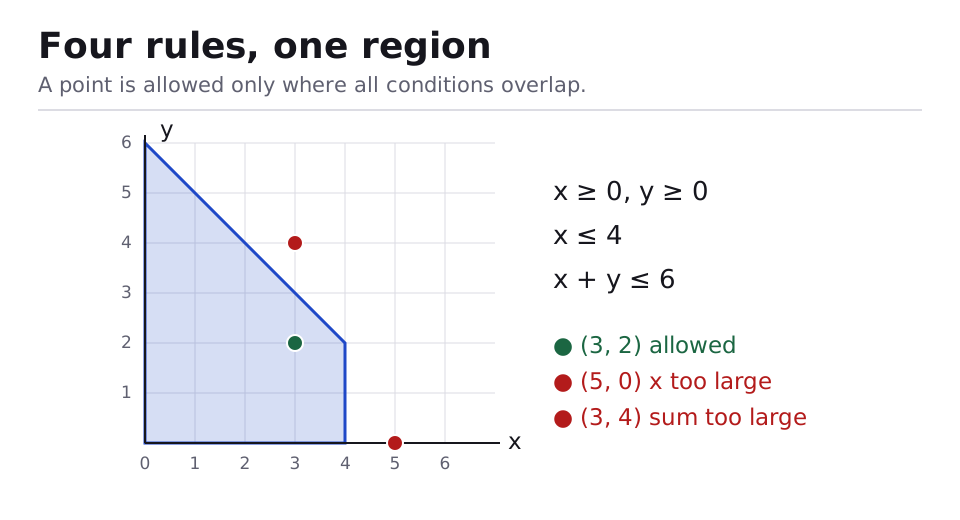
Suppose and are amounts of two materials. The rules , , , and define which pairs are allowed. The pair is feasible: it satisfies all four. The pair fails , even though it satisfies the other three. The pair fails .
Each inequality shades one side of a boundary line. Their common overlap is the feasible region. A boundary is included when its sign is or , and excluded when it is or .
A quick tour of common constraints
| Condition | Algebraic form | What it removes |
|---|---|---|
| Nonnegative quantity | Negative answers | |
| Whole-number count | Fractional counts | |
| Capacity | Combinations using too much | |
| Exact total | Pairs with the wrong sum | |
| Nonzero denominator | The undefined input | |
| Nonnegative square-root input | in | Inputs where the real square root is undefined |
A useful routine is write restrictions first, solve second, check last. When constraints give several inequalities, test each candidate against every original condition. A point can lie on one correct side of a graph and still fail another condition.
An algebraic rewrite can also hide a restriction. For ,
Cancelling the common factor does not make the original expression defined at . Similarly, multiplying both sides of an equation by an expression that can be zero can create an apparent solution; check any result in the original equation.
If no candidate meets all conditions, the problem has no feasible solution. This can be a genuine conclusion, not a failed calculation. A later optimization problem asks which feasible choice gives the best value; Module 5.4 builds on this distinction.
Application 1: two kinds of kits
A workshop can spend at most material units. A small kit uses units, and a large kit uses . It must make at least one small kit and at least two large kits. Can it make kits? What small-kit counts work if it makes exactly two large kits?
- Write every condition. are whole numbers, , , and .
- Check the proposed pair. At , material use is , so it is feasible. At the use would be , so that pair is not.
- Fix and solve. gives . With and a whole-number count, the possibilities are .
The inequality alone would admit many real values. The count and minimum rules narrow them to three choices.
Application 2: a cancelled denominator
Solve over the real numbers.
- Record the domain. The denominator is zero at , so .
- Simplify on that domain. Since , the equation becomes , which suggests .
- Check the original equation. At , the original fraction is , which is undefined. No allowed value remains.
The simplified equation has a solution, but the original problem has no solution. Keeping the restriction is part of solving, not an extra step after it.
Resources
| Source | Title | Why read it |
|---|---|---|
| OpenStax | Linear programming | See how several constraints bound a feasible region. |
| OpenStax | Models and applications | Practise applying a solution to the original situation. |
Finished this module? Mark it done.
Comments
Stuck on something, spotted a mistake, or found a resource that helped you? Tell us below.
Loading comments