INAIO Guide Stage 1 4Sequences and Recurrences
4.1 Arithmetic and geometric sequences
Distinguish a sequence from its series, then find terms and finite totals in arithmetic and geometric patterns.
Before looking for a pattern, distinguish the numbers from their total. A sequence lists numbers in order; a series adds the terms of a sequence. The same row counts or yearly balances can therefore answer two different questions: what is the value at a particular position, and what is the total up to that position?
This is foundational algebra. Start with OpenStax's arithmetic sequences, then its geometric sequences. You need substitution, powers, and finite sums from Modules 1 and 2.
A basic idea: a list and its sum
For example, is a finite sequence of four terms. Adding those terms gives the finite series . A comma separates terms in the sequence; a plus sign joins them in the series. If the list continues, write . The corresponding series begins ; this module deals with sums of a stated finite number of terms, not the question of whether an infinite sum has a value.
We label the terms , so means the term in position . We label the sum of the first terms :
Now ask how one term leads to the next. The sequence adds each time. It is arithmetic, with common difference . The sequence multiplies by each time. It is geometric, with common ratio . Both start at , but their later terms and series totals behave differently.
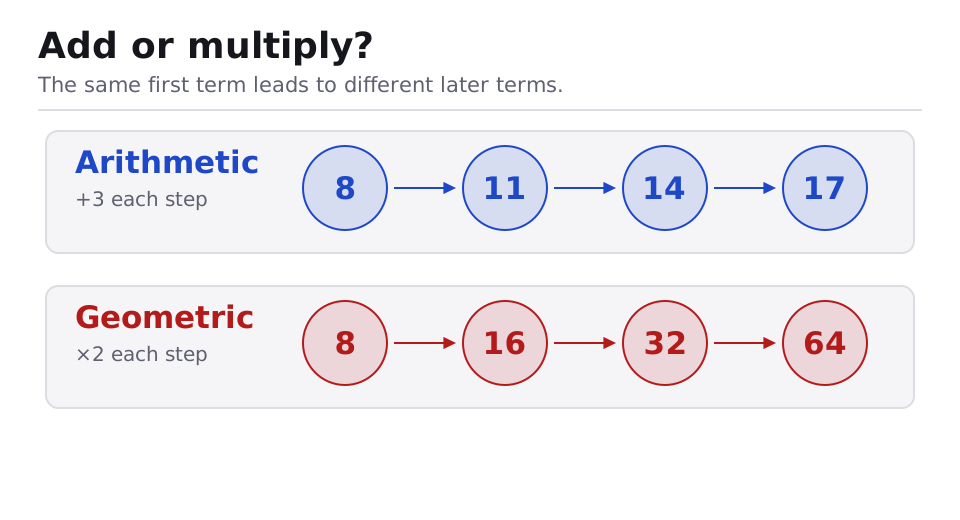
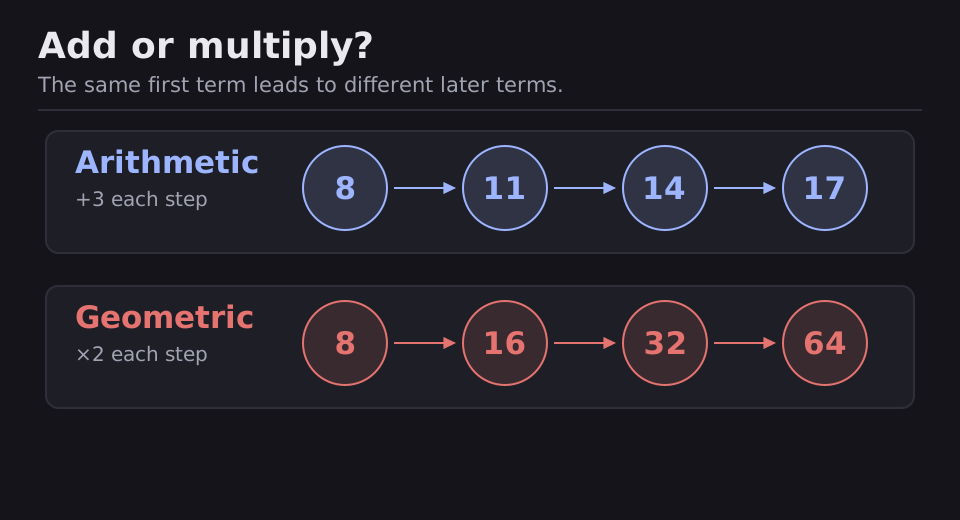
A quick tour of terms and sums
Number the first term . Reaching term takes steps, not steps:
If a problem starts at time , write or instead. Stating the starting index prevents an off-by-one error.
The sum of the first terms is a different question from the $n$th term. For an arithmetic sequence, the first and last terms average to , giving
For a geometric sequence with ,
One way to see the second formula is to write , then subtract ; all middle terms cancel. If , every term is and . A ratio is undefined when the previous term is zero, so check the actual rule rather than dividing blindly.
| Question | Arithmetic example | Geometric example |
|---|---|---|
| What comes next? | Add | Multiply by |
| What is term ? | ||
| What is the total so far? | Sum terms through | Sum terms through |
Application 1: seats in an auditorium
An auditorium has rows. The first has seats, and each following row has more than the one before it. How many seats are in the last row and in the auditorium altogether?
- Identify the rule. This is arithmetic: , .
- Find row 12. seats.
- Find the total. seats. The average row has seats, so checks the total.
Using additions instead of would invent a thirteenth row.
Application 2: messages that branch
In round 1, messages are sent. In each later round, every message produces two new messages. How many are sent in round 5, and how many are sent over all five rounds?
- Identify the ratio. The round counts are ; , .
- Find round 5. .
- Find the total. . Direct addition gives .
The fifth-round count and the five-round total answer different questions.
Resources
| Source | Title | Why read it |
|---|---|---|
| OpenStax | Arithmetic sequences | Learn common differences and finite sums. |
| OpenStax | Geometric sequences | Learn common ratios and finite sums. |
Finished this module? Mark it done.
Comments
Stuck on something, spotted a mistake, or found a resource that helped you? Tell us below.
Loading comments