INAIO Guide Stage 1 4Sequences and Recurrences
4.5 Growth, decay and transitions
Apply recurrences and state updates to repeated growth, decay, and movement between groups.
In Module 4.3, a recurrence used a starting value and a rule to find the next value. In Module 4.4, a state held several values that had to update together. We now use those same ideas to describe what changes during each period: a quantity can grow, shrink, or move between groups. The mathematical task is still to start from a known state, apply the update, and repeat.
Growth or decay means that a quantity changes by a fraction of its current size each period. A transition means that some of one group moves to another: people change locations, an item changes state, or probability moves through a network. The rates and time period are assumptions of a model; they determine its update rule.
Several earlier ideas meet here. Percentages and ratios turn a percentage change into a multiplier. Geometric sequences describe repeated multiplication, while exponential functions express the resulting value directly in terms of time. Transitions use the paired state from Module 4.4. This is intermediate material; OpenStax's geometric-sequence lesson is a place to revisit the repeated-multiplier foundation.
A basic idea: next equals current plus net change
If a population grows by each year, its increase is , where is the current population. Add that increase to the current value:
The new value becomes the starting value for the next year. If the population loses each year, subtract instead, giving . Adding or subtracting the same number each year would be a different, arithmetic model.
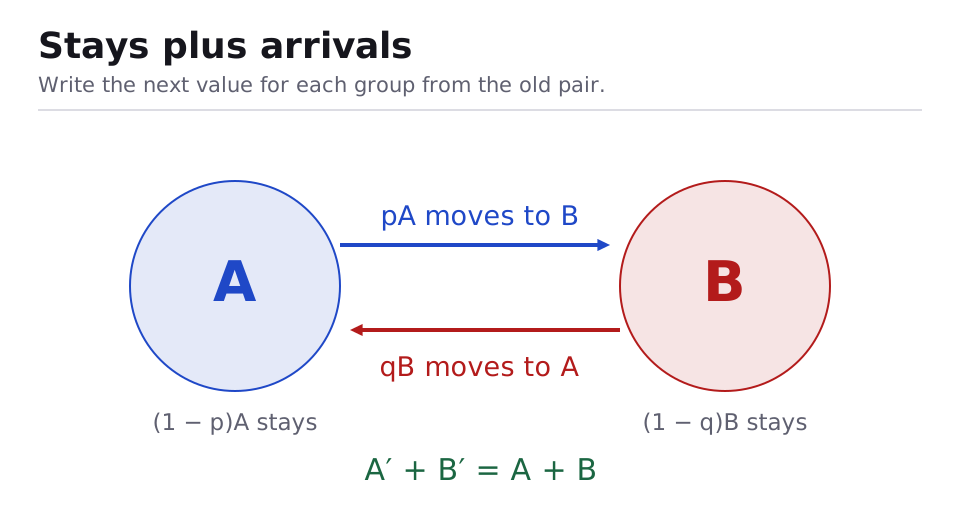
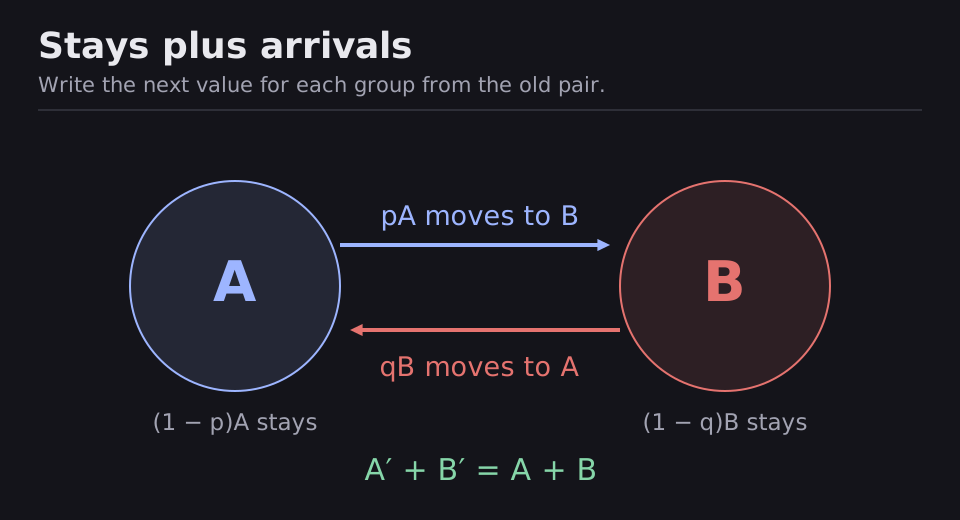
For two groups, the old state is . Write stays + arrivals for each new value. If fraction moves from to and fraction moves from to during one period, keeps and receives ; receives and keeps . Both new counts use the old state:
A quick tour of model checks
For a single group with rate , gives when the rate remains constant. A negative rate between and gives decay. Be clear about the time unit: per year is not per month.
For two groups, the fractions must lie between and . Adding the two update equations gives
The total is conserved because everyone leaving one group enters the other. If the model also includes births, deaths, or arrivals from outside, add those separately and do not expect conservation.
A steady state is a pair that does not change after an update. For the two-group model, this requires : the flow from to balances the reverse flow. This condition can help check the direction of a long-run pattern. Transition matrices later write both updates as one calculation.
These are models, not promises. Real populations may have changing rates, and a fractional calculation may represent an expected amount rather than a literal part of one person. State when and how rounding is used.
Application 1: repeated growth
An idealized population starts at and grows by at the end of each year. What does the model predict after three years?
- Use the yearly multiplier. with .
- Apply it three times. .
- Interpret. The model predicts about individuals after three years. Rounding at the end avoids changing later multiplications.
A fixed addition of per year would give , a different assumption.
Application 2: movement between two towns
At the start of a period, town has residents and town has . Each period, of moves to , while of moves to . What are the model values after two periods?
- Write simultaneous updates. and .
- First period. .
- Second period. .
- Check conservation. Both pairs sum to . These decimal values are model expectations; individual residents cannot be divided into tenths.
The flow into is initially larger than the flow out, so its model value rises.
Resources
| Source | Title | Why read it |
|---|---|---|
| OpenStax | Geometric sequences | Review repeated multiplication before adding transfers. |
| MIT OpenCourseWare | Centrality and Web Search | See a later use of repeated probability transitions. |
Finished this module? Mark it done.
Comments
Stuck on something, spotted a mistake, or found a resource that helped you? Tell us below.
Loading comments