INAIO Guide Stage 1 8Probability
8.3 Conditional probability
Restrict the sample space to a known condition, then divide the overlap by the probability of that condition.
The phrase “given that” changes a probability question. Once you know a result passed a filter, results outside that filter no longer belong in the denominator. This idea is needed for Bayes' theorem, classifier questions, and probability trees.
This is intermediate probability. Start with OpenStax's conditional-probability examples. A table of counts is often easier to read than a formula at first.
A basic idea: which group are we asking about?
Suppose a batch contains items, of which are faulty. If we choose an item at random without knowing anything else, the chance that it is faulty is . That is the ordinary, or unconditional, probability: the denominator is the whole batch.
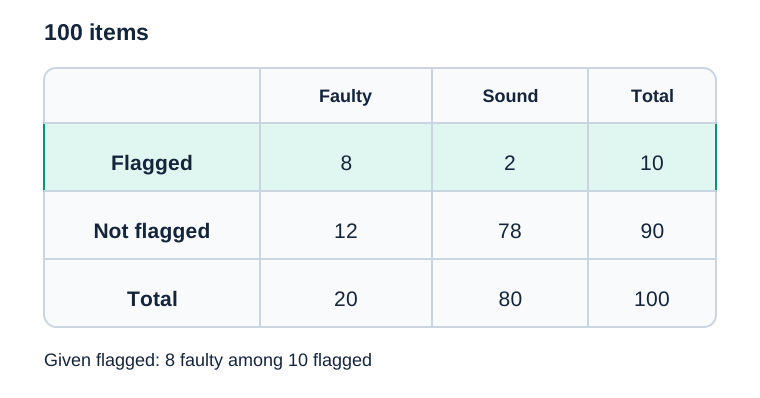
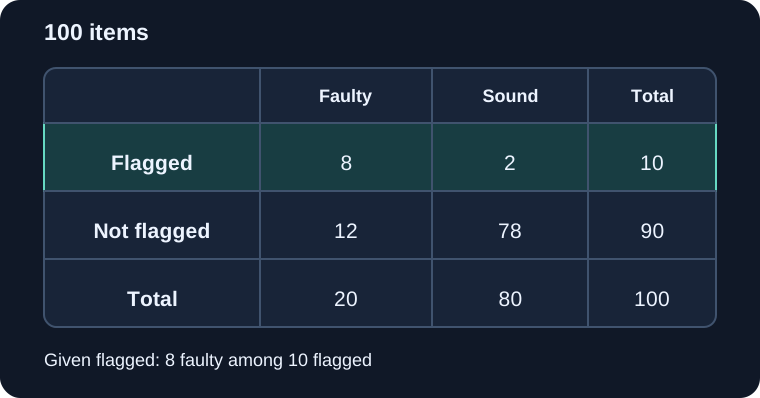
Now suppose we are told that the chosen item was flagged by a test. The table shows that only items were flagged: faulty and sound. The question has changed. We are no longer asking about faults among all items; we are asking about faults among the flagged items. That chance is . The test did not change the item. The new information changed which group we consider possible.
Let mean “faulty” and mean “flagged.” We write this new question as , read “the probability of given .” The event after the bar is the known condition. It supplies the new denominator; we then count how much of that smaller group also belongs to the event before the bar.
A quick tour of rules
If , then
Rearrange to get . You may instead condition on , but and generally differ. Always label which event is the known condition.
Application 1: a filtered die roll
A fair die shows an even number. What is the probability that it is greater than ?
- The condition leaves .
- Of these three equally likely outcomes, are greater than .
- The answer is , not from the original die.
Application 2: a flagged batch
Out of 100 items, 20 are faulty. A test flags 8 faulty items and 2 sound items. If an item chosen at random is flagged, what is the chance it is faulty?
- The known condition is “flagged,” which occurs for items.
- The overlap “faulty and flagged” contains items.
- .
By contrast, . Reversing the condition changes the denominator.
Resources
| Source | Title | Why read it |
|---|---|---|
| OpenStax | Probability terminology | See conditional probability as a reduced sample space. |
Finished this module? Mark it done.
Comments
Stuck on something, spotted a mistake, or found a resource that helped you? Tell us below.
Loading comments