INAIO Guide Stage 1 2Algebra and Equations
2.3 Solving quadratic equations
Solve square-term equations by factoring, completing the square, or using the quadratic formula.
Quadratic equations appear when a variable is squared. Areas, trajectories, and many optimization questions produce them. Solving one means finding every input that makes the equation true. Unlike a usual linear equation, a quadratic can have two, one, or no real solutions.
This is foundational to intermediate algebra. Be comfortable with distribution and factoring from Module 2.1 and balancing equations from Module 2.2. OpenStax's quadratic-equations lesson gives further worked practice.
A basic idea: where does the expression reach zero?
An equation such as is quadratic because the highest power of is . If we can write the left side as , the product is zero when either factor is zero. Thus and are its roots. On the graph of , they are the points where the curve meets the horizontal axis.
The square-root symbol has one nonnegative value, but solving gives both and . That is why a appears when we take square roots while solving.
A quick tour of methods
Factor when the product is simple
First move all terms to one side so the other side is zero. For , find two numbers that multiply to and add to : they are and . Then , so or . If the leading coefficient is not , look for a common factor first and verify a proposed factorization by expanding it.
Complete the square when factoring is awkward
The identity tells us how to turn into a square: take half of , then square it. To solve , move the constant and add the same to both sides:
Taking both square-root possibilities gives , so . The new is not guessed: it is . The diagram shows why adding that small corner makes a full square.
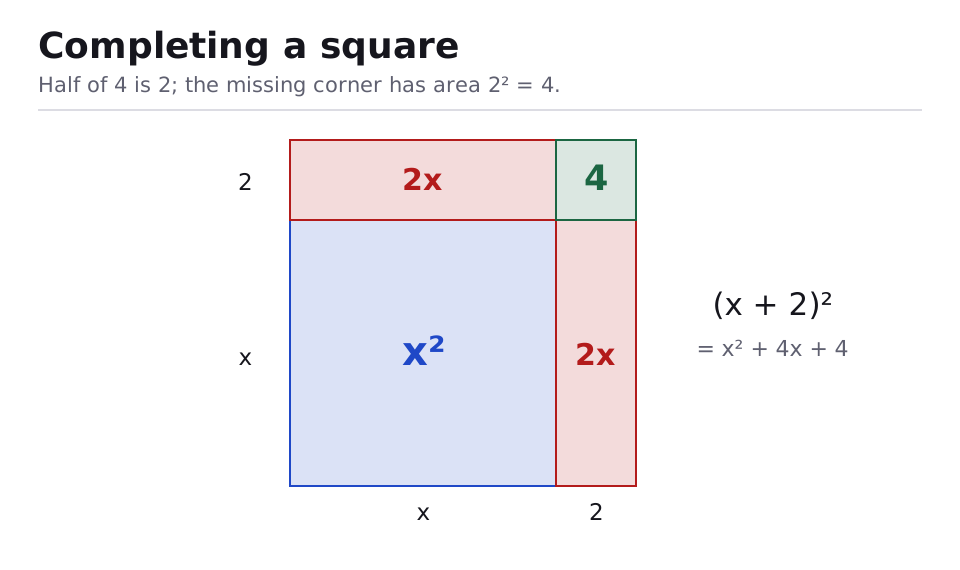
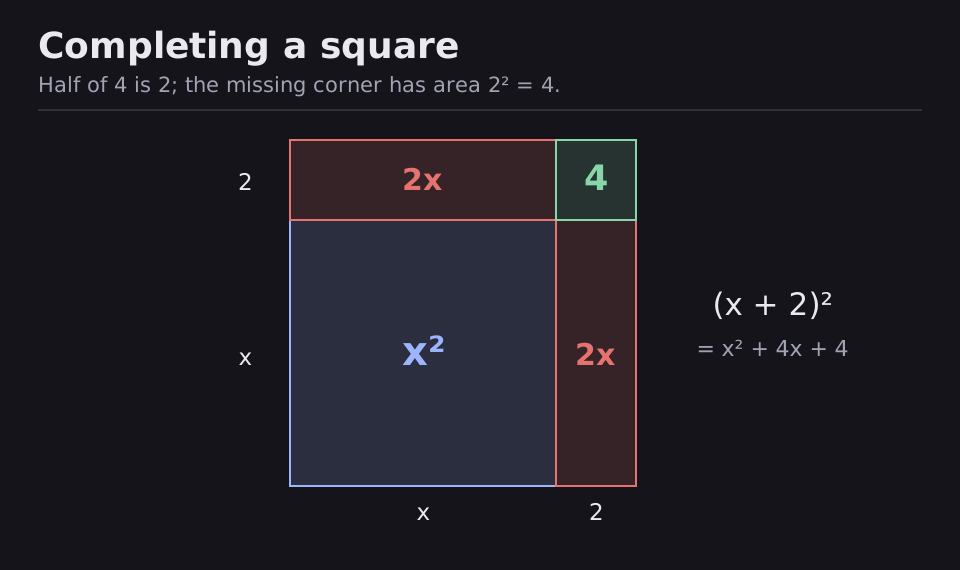
The picture uses positive side lengths to explain the identity. The algebraic identity remains true for every real .
Use the general formula and count real roots
For with , completing the square gives
The number is the discriminant. If , there are two distinct real roots; if , one repeated real root; if , no real roots. The formula always applies, but factoring or completing the square can explain a problem more clearly. Check roots in the original equation, especially after moving or dividing terms.
Application 1: the sides of a rectangle
A rectangle has area square units. Its length is one unit more than its width. Find both sides.
- Name the width. Let it be ; then the length is , and .
- Move to zero and factor. , giving or .
- Apply the meaning and check. A width cannot be negative, so . The sides are and , and their area is .
Both numbers solve the algebraic equation, but only one describes a rectangle. Module 2.6 studies such restrictions.
Application 2: an equation that does not factor neatly
Solve over the real numbers.
- Move the constant. .
- Complete the square. Half of is , and . Add to both sides: .
- Take both square roots. or . Substitution confirms each: if , then , exactly the rearranged equation.
The solutions are approximately and . Rounding early would lose accuracy, so keep the exact square-root form until the last step.
Resources
| Source | Title | Why read it |
|---|---|---|
| OpenStax | Quadratic equations | Practise factoring, completing the square, and the quadratic formula. |
Finished this module? Mark it done.
Comments
Stuck on something, spotted a mistake, or found a resource that helped you? Tell us below.
Loading comments