INAIO Guide Stage 1 2Algebra and Equations
2.2 Linear equations and systems
Keep an equation balanced, solve for one unknown, and find values that satisfy two equations at once.
An expression tells us how to calculate a quantity. An equation says that two quantities are equal and asks when that statement is true. A system asks for values that make several equations true at the same time. These ideas appear whenever two descriptions of the same situation must agree: a total price, a measured distance, or two counts with a shared total.
This is foundational algebra. Review the expression rules in Module 2.1, then use OpenStax's one-variable equations before its two-variable systems. You need only substitution and arithmetic to start.
A basic idea: preserve the balance
Consider . The left and right sides have the same value only for certain . Subtracting from both sides leaves ; dividing both sides by gives . Checking in the original equation gives .
An equation is like a balanced scale: adding or subtracting the same quantity on both sides preserves its solutions, as does multiplying or dividing by the same nonzero number. Dividing by a variable requires care because that variable might be zero. For example, dividing by would lose the valid solution .
A quick tour of equations and systems
One unknown
A linear equation in one variable can be rearranged to . If , it has the single solution . Simplify brackets, gather the variable terms on one side, gather constants on the other, then check the result in the original equation.
If rearrangement instead produces , there is no solution: no value can make a false statement true. If it produces , every allowed value works. For instance, is true for all real .
Two unknowns at once
In a system such as
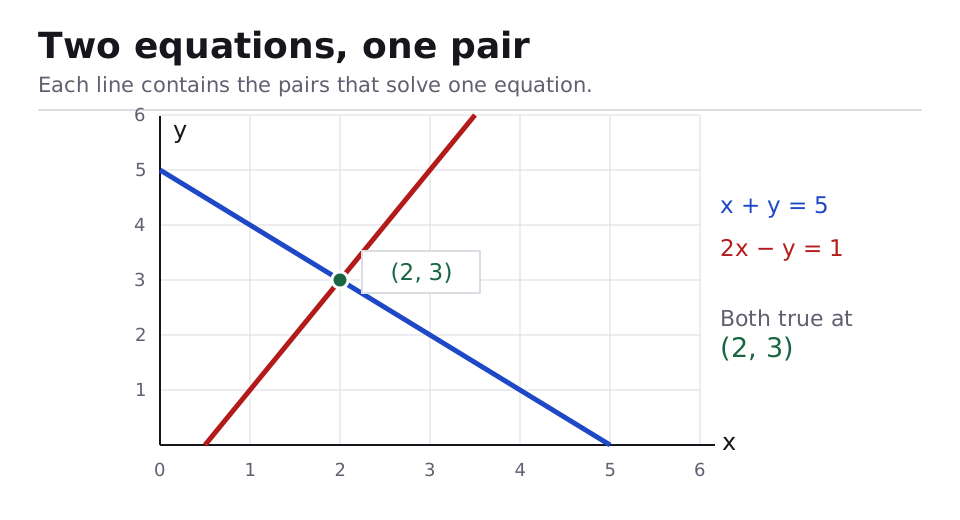
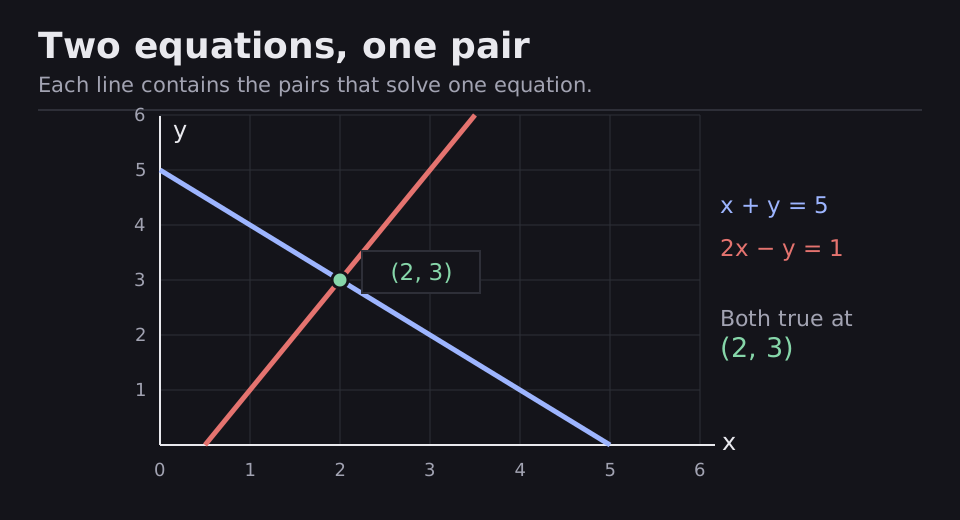
a solution is a pair that satisfies both equations. Adding the equations removes : , so and then . Substitution checks both: and .
Two common methods are:
| Method | What you do | Good time to use it |
|---|---|---|
| Substitution | Express one variable using the other, then put it into the second equation. | One variable is already isolated or easy to isolate. |
| Elimination | Add or subtract equations after matching coefficients, removing one variable. | Coefficients already match or can be matched easily. |
Graphically, each two-variable linear equation is a line. The two graphs can cross once, run parallel and never meet, or coincide. Their system then has one, zero, or infinitely many solutions, respectively. The equations and cross at .
For more than two unknowns, the same idea continues: every equation must hold. Matrix methods in Module 11.4 organise larger systems.
Application 1: an equation with brackets
Solve .
- Expand the left side. .
- Collect terms. Subtract from both sides, then add : .
- Solve and check. . The original sides are and .
Checking in the original form catches a missed term when expanding.
Application 2: adult and child tickets
A group buys tickets. Adult tickets cost units, child tickets cost units, and the total paid is units. How many of each were bought?
- Name the unknowns. Let be adult tickets and child tickets. Then and .
- Substitute. From the count equation, . Thus , or .
- Find and check both counts. and . They add to , and .
The count and cost equations tell us different things. Both are needed to determine the pair.
Resources
| Source | Title | Why read it |
|---|---|---|
| OpenStax | Linear equations in one variable | Start with balancing and checking one-variable equations. |
| OpenStax | Systems of linear equations: two variables | Compare graphing, substitution, and elimination. |
Finished this module? Mark it done.
Comments
Stuck on something, spotted a mistake, or found a resource that helped you? Tell us below.
Loading comments