INAIO Guide Stage 1 5Calculus and Optimisation
5.4 Constrained optimisation
Optimize only among choices that satisfy the stated equality, inequality, and domain restrictions.
The best value of a formula may be impossible in the actual problem. A rectangle cannot have a negative side, a machine cannot exceed its capacity, and an exact total must remain exact. Constrained optimization means finding the best value among the choices that satisfy every rule.
This is intermediate work built on feasible solutions and maxima and minima. OpenStax's applied-optimization lesson starts from a real situation; its linear-programming lesson shows two-variable inequality constraints.
A basic idea: the allowed set comes first
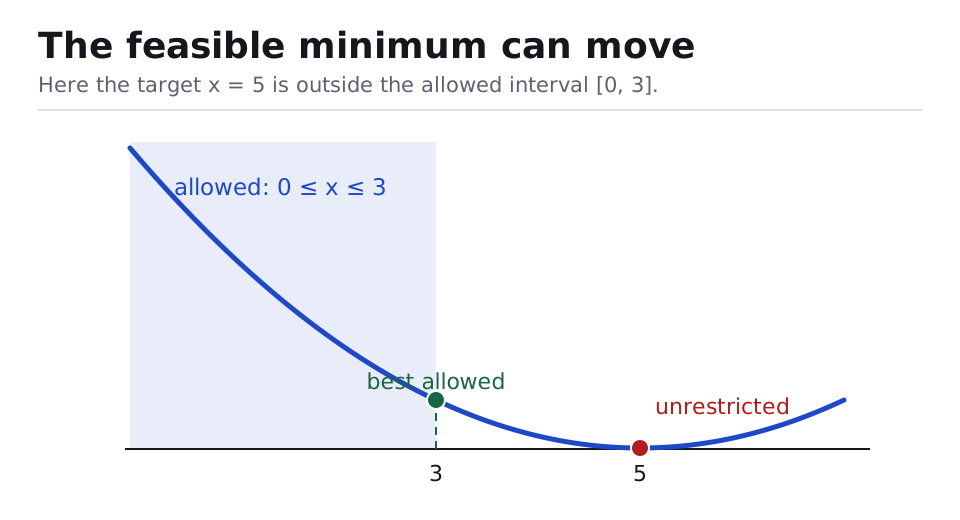
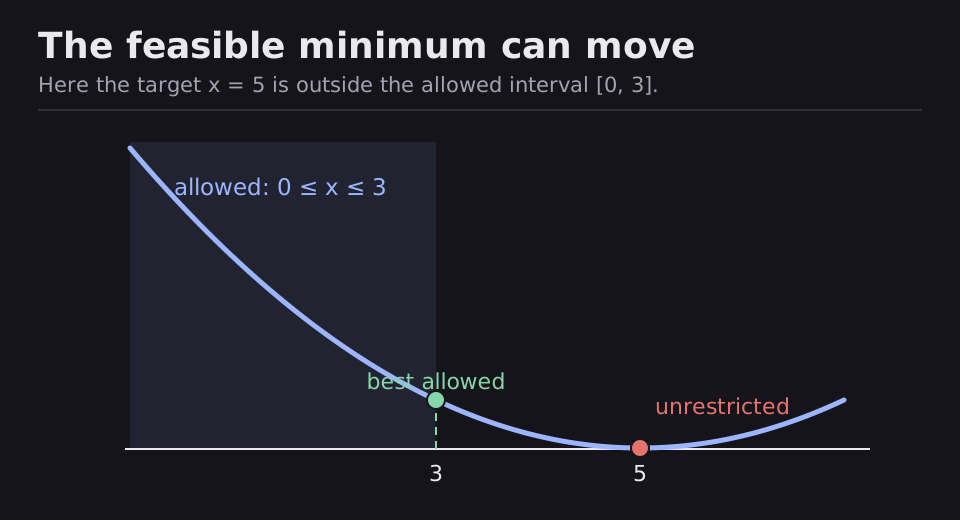
Suppose measures error, but a control can only be set between and . Without the restriction, would give zero error. It is not allowed. On , moving towards always lowers the error, so is the feasible minimum, with .
A quick tour of a constrained problem
- Name the objective. Write the quantity to maximize or minimize, including its units.
- List every constraint. Include equalities, inequalities, positive lengths, whole-number counts, and forbidden values.
- Reduce if possible. An equality such as lets you replace with . Then carry its allowed range into the one-variable problem.
- Find candidates and compare. For a smooth one-variable objective, check interior critical points and allowed boundaries. In two variables, edges and corners may also be candidates.
- Return to the question. State the feasible choice and its objective value, then substitute into the original conditions.
An equation constraint restricts choices to a curve or line. An inequality keeps one side of a boundary. You cannot simply solve the unconstrained derivative equation and stop: its answer may lie outside the feasible region. If no choice satisfies all conditions, there is no feasible optimum. If a boundary is excluded, a best value may be approached without being attained.
For a two-variable region, check each included edge as a one-variable problem: replace its boundary condition with an equality, substitute into the objective, and keep the allowed range along that edge. Compare any best points on the edges with their corners and with feasible interior candidates. When the objective is linear and the region is a closed, bounded polygon, at least one maximum and one minimum occur at corners; a nonlinear objective can do best between corners.
Application 1: area with a fixed perimeter
A rectangle has perimeter units. What side lengths give the greatest area?
- Use the equality. If the sides are and , then , so . Positive side lengths require .
- Build the objective. .
- Maximize within the domain. The squared term is smallest at , which is allowed. Thus and the maximum area is square units.
Completing the square makes the answer clear without a derivative; gives the same candidate.
Application 2: a limited control setting
A control setting must satisfy . Its error is . Which setting minimizes error?
- Find the unrestricted target. and would reach at .
- Apply the constraint. Since is outside , compare allowed values. throughout , so error falls as increases.
- Choose the boundary. gives minimum error .
The derivative identifies the direction to move; the limit on decides where to stop.
Resources
| Source | Title | Why read it |
|---|---|---|
| OpenStax | Applied optimization problems | Practise turning restrictions into a one-variable objective. |
| OpenStax | Linear programming | See objectives and several simultaneous inequalities. |
Finished this module? Mark it done.
Comments
Stuck on something, spotted a mistake, or found a resource that helped you? Tell us below.
Loading comments