INAIO Guide Stage 1 8Probability
8.2 Independent and dependent events
See how events relate through dependence, then use the first result to find the correct chance for the next.
When a question involves multiple events, we can describe how they relate in terms of dependence: the events are either independent or dependent. They are independent if learning that one happened does not change the chance of the other. They are dependent if it does change that chance. This distinction matters in multi-step questions—two tosses, two draws, or two tests—because the chance at a later step may depend on an earlier result.
This is foundational to intermediate probability. Learn the definition in OpenStax's section on independent events, then practise the multiplication rule. Module 8.3 explains conditional probability in more detail.
A basic idea: did the first draw change the next chance?
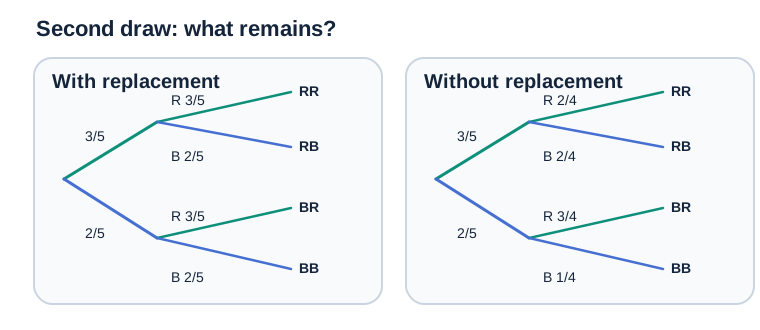
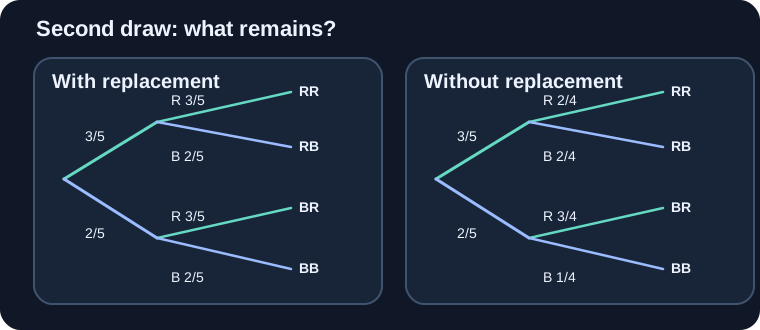
Take a bag with three red and two blue balls and draw twice. Let the first event be “the first ball is red” and the second event be “the second ball is red.” Before either draw, a red ball has chance .
In the with-replacement picture, we put the first ball back before drawing again. The bag still has three red and two blue balls, whether the first draw was red or blue. The chance of red on the second draw stays . The two events are independent.
In the without-replacement picture, the first ball stays out. If it was red, only two red balls remain among four, so the next red chance is . If it was blue, all three red balls remain among four, so that chance is . Knowing the first result now changes the chance of the second event: the events are dependent.
A quick tour of definitions and rules
Let be the first event and the second. When , means the probability of given that happened. Module 8.3 develops this conditional probability in detail. Formally, the events are independent when , and dependent when these probabilities differ.
For either relationship, the multiplication rule is
Here means that both events happen. For independent events, , so the rule simplifies to . For dependent events, use the chance of after , as the without-replacement tree does. The same idea extends along a tree: multiply branch probabilities on one path, then add the probabilities of separate paths that meet your goal.
Independent does not mean mutually exclusive. Two mutually exclusive events with positive probabilities cannot be independent: observing one rules out the other.
Application 1: two fresh tosses
What is the chance that two fair coin tosses are both heads?
- Each toss has .
- Separate tosses do not affect each other, so the second toss is still whatever the first showed.
- .
Application 2: drawing without replacement
A bag contains three red and two blue balls. You draw two without replacing the first. What is the chance that both are red?
- The first red has probability .
- After that draw, two red balls remain among four balls, so the next probability is .
- .
Using would describe drawing with replacement, a different experiment.
Resources
| Source | Title | Why read it |
|---|---|---|
| OpenStax | Independent and mutually exclusive events | Learn the independence test and how it differs from disjoint events. |
| OpenStax | Two basic rules of probability | Practise multiplying conditional probabilities. |
Finished this module? Mark it done.
Comments
Stuck on something, spotted a mistake, or found a resource that helped you? Tell us below.
Loading comments