INAIO Guide Stage 1 10Coordinate Geometry and Vectors
10.1 Cartesian coordinates
Read ordered coordinates, plot positions, and turn inequalities into regions on a plane.
Coordinates convert a picture or physical location into numbers. They let you describe positions, compare locations, and state which points satisfy a constraint. This is the base for distance, vectors, and geometric optimization.
This is foundational geometry. Begin with OpenStax's coordinate-plane lesson. You only need signed numbers and simple inequalities.
A basic idea: ordered positions
A point is located by moving units horizontally and units vertically from the origin . Positive points right; positive points up. Order matters: and are different points.
A quick tour of properties
The axes divide the plane into four quadrants, numbered I to IV anticlockwise from the top right: I has ; II has ; III has ; IV has . A point on an axis has at least one coordinate equal to zero (the origin has both). Between and , the horizontal and vertical changes are and . The midpoint is . An inequality such as includes its boundary line and every point on one side of it (here, the side containing the origin).
Application 1: a robot's position
A robot starts at and moves five units right and three units down. Where does it finish?
- Add to the horizontal coordinate: .
- Subtract from the vertical coordinate: .
- Its final position is , in the fourth quadrant.
Application 2: a feasible location
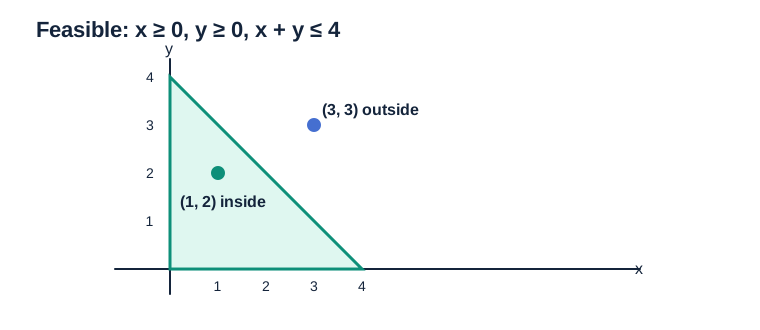
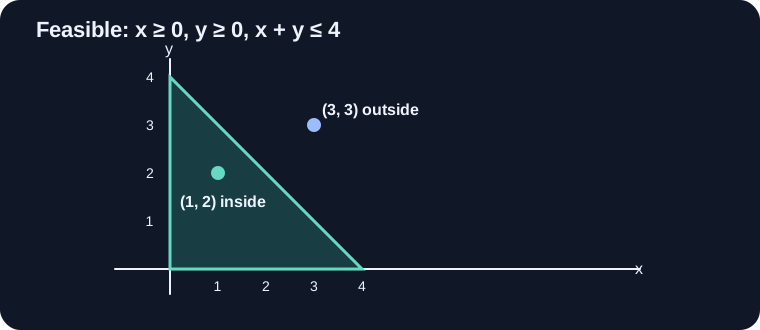
A point must satisfy , , and . Is feasible? Is ?
For , both coordinates are nonnegative and , so it is feasible. For , , so it is outside the region. The boundary is included because the sign is .
Resources
| Source | Title | Why read it |
|---|---|---|
| OpenStax | The rectangular coordinate systems and graphs | Learn axes, plotting, and coordinate differences. |
Finished this module? Mark it done.
Comments
Stuck on something, spotted a mistake, or found a resource that helped you? Tell us below.
Loading comments