INAIO Guide Stage 1 9Random Variables and Expected Value
9.6 Expected costs and decisions
Compare actions by their probability-weighted rewards or costs, while keeping the assumptions and risk limits visible.
Expected value in Module 9.2 describes the average outcome of one random quantity. A decision adds a choice: each available action changes the possible rewards, costs, or their probabilities. We calculate the expected result for each action and compare them. This is useful in reliability planning and in AI systems that must choose whether to raise an alert.
This is intermediate probability and decision-making. OpenStax's expected-value lesson works through payoff problems; its statistics lesson reviews the weighted-average calculation. You should be comfortable listing a small distribution before comparing actions.
A basic idea: put actions on the same scale
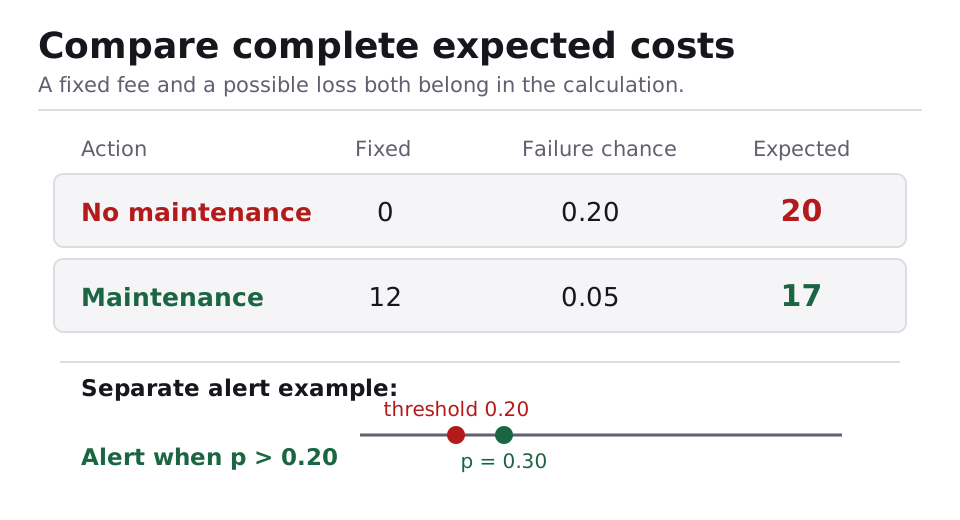
Suppose a machine failure costs . Without maintenance, failure probability is , so expected cost is . Maintenance costs and lowers failure probability to , so its expected cost is . On the stated assumptions, maintenance saves in expectation. It does not save exactly in each individual run.
A quick tour of decision rules
For action and possible outcomes , define its reward or cost . Then
Include fixed fees, losses, and gains on the same scale. To choose by expected value alone, maximize expected net reward or minimize expected total cost. Never compare a gross reward for one action with a net reward for another.
For a yes-or-no alert, suppose the event probability is , a false alert costs , and a missed event costs , while correct decisions have zero cost. Alerting has expected cost ; staying quiet has cost . Alert when
with either action tied at equality. This threshold follows by comparing the two costs; it is not a universal probability cutoff. Expected cost is one criterion: a budget limit, a catastrophic downside, or uncertain probability estimates may require a different decision rule. This module does not develop risk measures beyond expectation.
Application 1: preventive maintenance
A failure costs . Its probability is without maintenance, or after a maintenance job. Which action has lower expected cost?
- Without maintenance, .
- With maintenance, .
- Choose maintenance under the expected-cost criterion; its expected cost is lower by .
Application 2: a model alert
A model estimates a chance of an event. A false alert costs ; missing a real event costs . Correct decisions have zero cost. Should the system alert?
- Alert: only a false alert costs anything, so .
- Stay quiet: only a missed event costs anything, so .
- Alert has lower expected cost. The threshold is , and exceeds it. This assumes the estimated probability and stated costs are credible.
Resources
| Source | Title | Why read it |
|---|---|---|
| OpenStax | Expected value | Practise net-payoff and decision comparisons. |
| OpenStax | Mean or expected value and standard deviation | Review probability-weighted averages. |
Finished this module? Mark it done.
Comments
Stuck on something, spotted a mistake, or found a resource that helped you? Tell us below.
Loading comments