INAIO Guide Stage 1 9Random Variables and Expected Value
9.4 Binomial probabilities
Recognize fixed independent success-or-failure trials and calculate exact or at-least binomial probabilities.
Repeated yes-or-no experiments occur in quizzes, reliability tests, and model predictions. The binomial distribution counts how many successes occur, provided the trial setup stays the same each time.
This is intermediate probability. Learn the conditions and examples in OpenStax's binomial-distribution lesson. Independent trials explain why we multiply their probabilities; combinations explain how many success orders have the same count.
A basic idea: count successes
A Bernoulli trial has two outcomes, success and failure, with success probability . Let count successes across trials. is binomial when is fixed, trials are independent, each trial has two outcomes, and the same applies each time.
A quick tour of formulas
For ,
The factor chooses which trials succeed. Each such sequence has probability . The mean count is . For at least one success, the complement gives . If trials change or affect each other, do not apply this formula automatically.
Application 1: exactly three correct answers
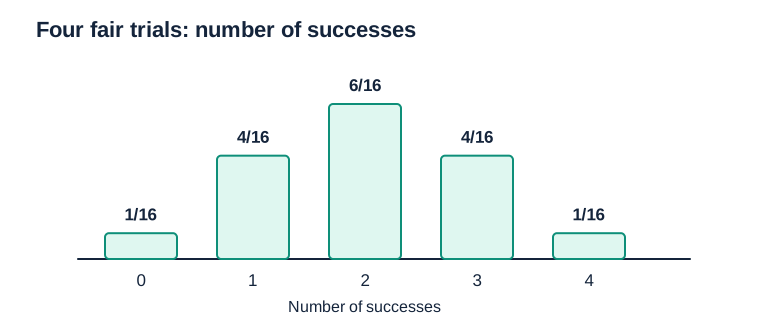
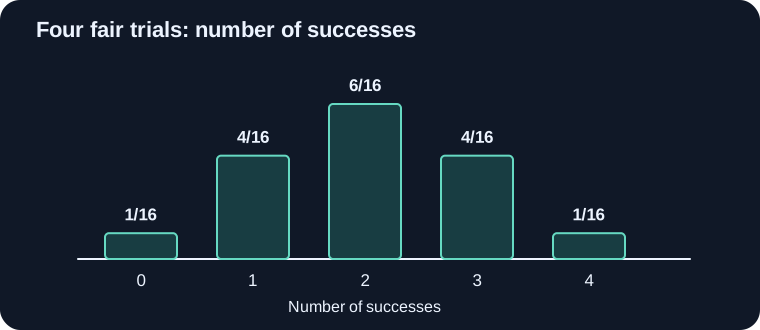
You guess independently on four true-or-false questions. What is the chance of exactly three correct answers?
- , , and .
- There are ways to place the one wrong answer.
- .
Application 2: at least two failures
Each of five independent parts fails with probability . What is the chance that at least two fail?
- Use the complement: “at least two” is the opposite of “zero or one.”
- and .
- .
The calculation assumes independent parts and the same failure chance for each. A shared power supply could violate independence.
Resources
| Source | Title | Why read it |
|---|---|---|
| OpenStax | Binomial distribution | Check the binomial conditions and practise the probability formula. |
Finished this module? Mark it done.
Comments
Stuck on something, spotted a mistake, or found a resource that helped you? Tell us below.
Loading comments