INAIO Guide Stage 1 2Algebra and Equations
2.4 Linear and quadratic inequalities
Solve linear limits and quadratic sign questions, then show exactly which values qualify.
An equation asks where two expressions are equal. An inequality asks where one is larger or smaller. A budget, a minimum score, and a safety limit usually allow a range of answers. For a quadratic expression, the answer can be one interval or two separated intervals, so locating its roots is only the first step.
This is foundational to intermediate work. Review numerical inequalities in Module 1.3 and equations in Modules 2.2 and 2.3. OpenStax's inequality lesson gives further practice.
A basic idea: ask which side of a boundary works
The equation identifies the boundary . The inequality asks which side makes the expression positive: every works. A strict sign, or , excludes its boundary; or includes it. We can write as the interval , where the round bracket means is excluded.
A quick tour of inequalities
Linear inequalities
Add or subtract the same value on both sides just as for equations. Multiplying or dividing by a positive number keeps the sign's direction. A negative number reverses it: from , dividing by gives . Check with : the original says , so zero must be in the answer.
If you do not know whether a multiplier is positive or negative, do not divide by it without considering both cases. A variable could also be zero. Compound inequalities such as require both conditions: subtract throughout, divide by , and get , or .
Quadratic inequalities
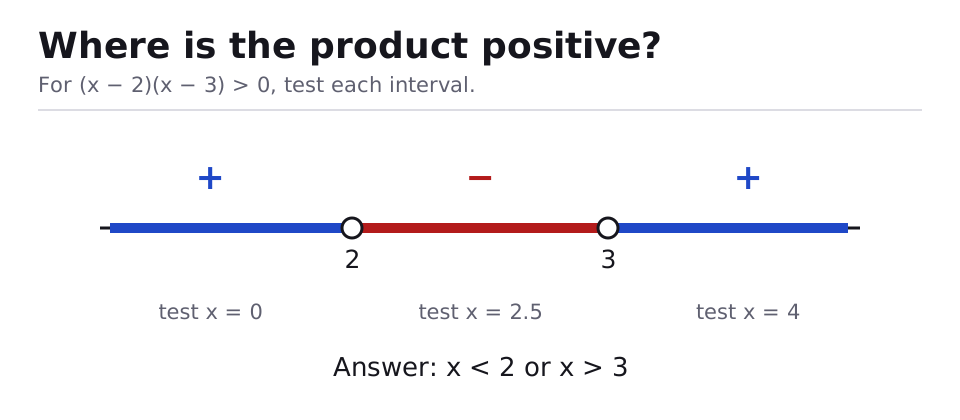
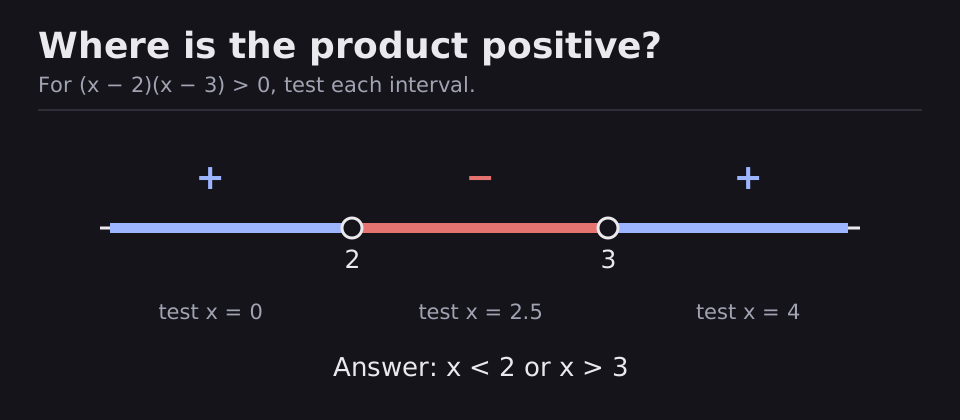
To solve , factor it as . The roots and split the number line into three intervals. The sign cannot change inside one of those intervals without another root, so test one point in each:
| Interval | Test point | Product sign | Included? |
|---|---|---|---|
| Yes | |||
| No | |||
| Yes |
Thus the answer is . The roots are excluded because the inequality is strict. If the question had asked for , both roots would be included. An upward-opening quadratic is positive outside two distinct roots and negative between them; a downward-opening one has the reverse pattern. Testing intervals still works when the pattern is not obvious.
An inequality involving a fraction also needs the points where its denominator is zero as boundaries. Those points can never be included, even if a simplified expression seems to allow them.
Application 1: a spending limit
A delivery has a fixed cost of units plus units per package. You can spend at most units. How many packages can you send?
- Write the limit. For a whole-number package count , .
- Solve. Subtract and divide by positive : .
- Use the context. The possible counts are . Seven costs ; eight costs and exceeds the budget.
The real-number inequality has infinitely many answers, but package counts must be whole numbers.
Application 2: when a score is positive
For which real is strictly positive?
- Find boundaries. , so its zeros are and .
- Test all intervals. At , ; at , ; at , .
- Handle endpoints. Strict positivity excludes and . The solution is or .
Solving found only the boundaries. The inequality required a sign check on both sides of them.
Resources
| Source | Title | Why read it |
|---|---|---|
| OpenStax | Linear inequalities and absolute value inequalities | Review inequality operations and interval notation. |
| OpenStax | Quadratic equations | Review how to find the roots that divide a sign chart. |
Finished this module? Mark it done.
Comments
Stuck on something, spotted a mistake, or found a resource that helped you? Tell us below.
Loading comments