INAIO Guide Stage 1 9Random Variables and Expected Value
9.5 Waiting-time problems
Count trials until the first success, distinguish independent repeats from draws without replacement, and compute the wait distribution.
In Module 9.4, we fixed the number of trials and counted successes. Now reverse the question: keep trying until the first success and ask how long it takes. This is a waiting-time problem. The answer depends on whether each attempt still has the same success chance after previous failures.
This is intermediate probability. OpenStax's geometric-distribution lesson covers independent first-success trials; revisit its binomial lesson to compare the two questions. Conditional probability is needed when an attempt changes what remains.
A basic idea: failures before one success
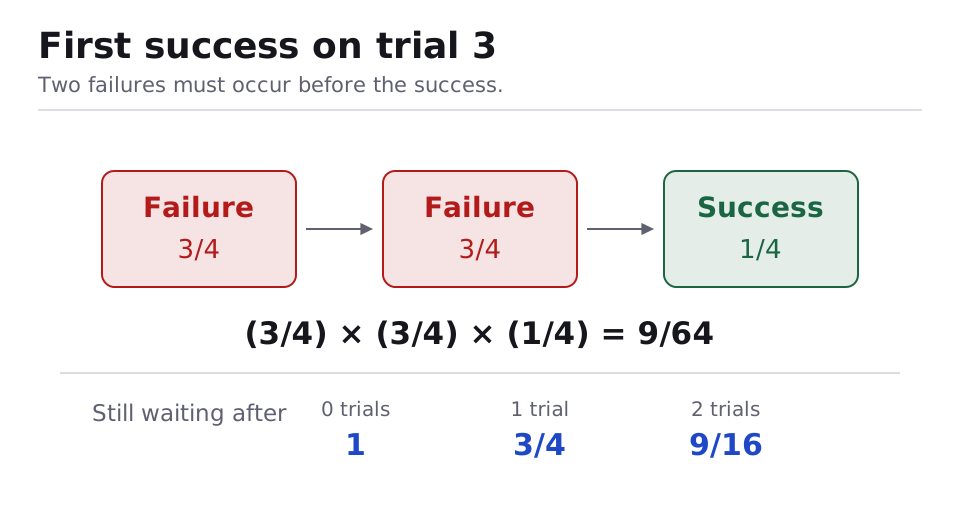
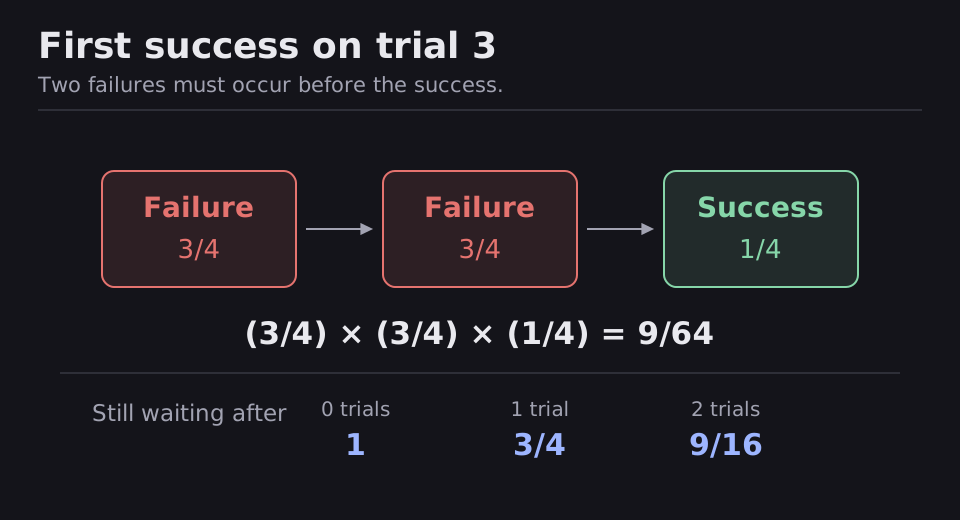
Suppose each independent repair attempt succeeds with chance . To succeed for the first time on attempt 3, the first two must fail and the third must succeed: . It is important that “first on attempt 3” excludes a success on attempts 1 or 2.
A quick tour of waiting-time rules
Let be the number of trials including the first success. If trials are independent and every trial succeeds with the same probability , then has a geometric distribution:
The first expression needs failures then one success. The second needs failures on all of the first trials. The expected wait is . One way to see it is to let be the expected number of trials: one trial is used immediately; with probability it fails and the process restarts with the same expected wait. Thus , giving .
If trials are without replacement, the chance of success usually changes after each failure. Then multiply the actual conditional branch probabilities or enumerate possible stopping times; do not automatically use the geometric formula. Also check whether the question counts trials until success or failures before success—the latter is .
Application 1: repeated repair attempts
Independent repair attempts each succeed with probability . Find the probability that the first success is on attempt , and the expected number of attempts.
- Attempts 1 and 2 fail with probability each, then attempt 3 succeeds with probability .
- .
- attempts. This average is not a promise that success occurs by attempt 4.
Application 2: drawing without replacement
A bag contains three red and two blue balls. Draw without replacement until the first red. What is the expected number of draws?
- . To stop at , draw blue then red: .
- To stop at , draw both blues first: . These probabilities total .
- draws. Using would be wrong because the success probability changes after a blue draw.
Resources
| Source | Title | Why read it |
|---|---|---|
| OpenStax | Geometric distribution | Learn the first-success formula and its expected wait. |
| OpenStax | Binomial distribution | Compare a fixed trial count with waiting until success. |
Finished this module? Mark it done.
Comments
Stuck on something, spotted a mistake, or found a resource that helped you? Tell us below.
Loading comments