INAIO Guide Stage 1 2Algebra and Equations
2.1 Simplifying expressions
Read an expression, collect like terms, and use the distributive rule without changing its value.
Algebra lets one rule describe many numbers at once. Instead of calculating the cost of 2, 3, and 4 items separately, we can write a rule for items and substitute whichever value we need. Simplification makes that rule easier to read and use. It also prepares us to solve equations in the next module.
This is foundational mathematics. You need arithmetic and the order of operations; you do not need to know how to solve an equation yet. For a first course, use OpenStax's polynomial lesson. Its factoring lesson is useful after you are comfortable expanding brackets.
A basic idea: a rule with a blank
In , is a variable, is its coefficient, and and are terms. Putting into the expression gives . An expression is a quantity such as ; it makes no claim that this quantity equals another one. An equation, such as , does make that claim and asks which values of make it true.
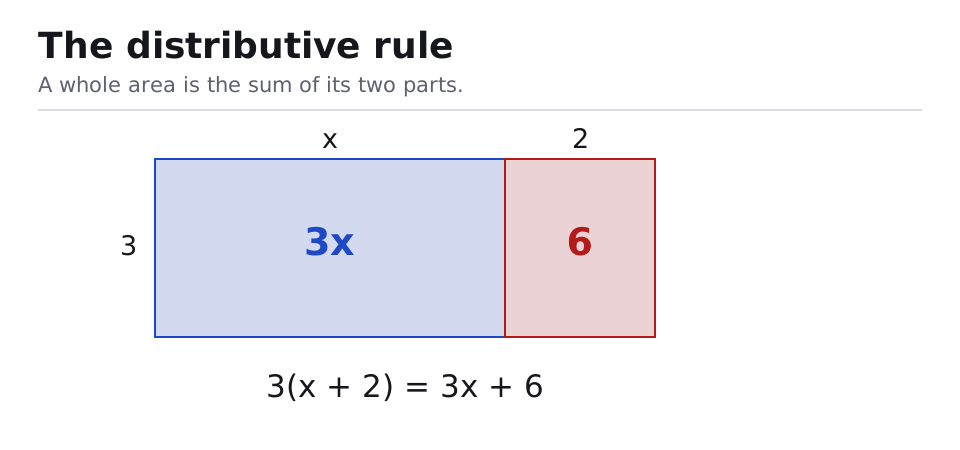
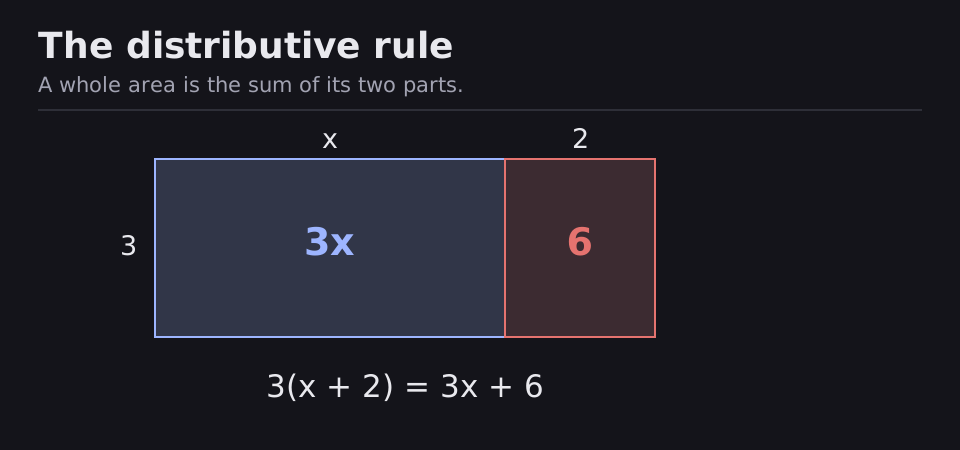
The expressions and look different but give the same value for every . We call them equivalent. Multiplying the by both terms inside the bracket is what makes the rewrite valid.
A quick tour of simplification
Substitute, then calculate
Replace each variable with its given value before doing arithmetic. If , then , but . The brackets matter: they make the negative number the base of the square.
Combine like terms
Terms are like terms when their variable parts match exactly. Thus , and . A term in cannot merge with a term in : for example, remains . Constants combine with constants.
Distribute and collect
Multiplication passes through a sum:
For example, . The minus before a bracket changes the sign of every term inside it. You can check the rewrite at : both expressions give . One numerical check can catch an error, although it does not prove two expressions are always equal.
Expanding removes brackets by multiplying. Factoring reverses that move: . Choose the form that helps with the next task. The expanded form shows separate contributions; the factored form shows a shared multiplier. Module 2.3 uses factoring to solve quadratic equations.
| Goal | Useful move | Example |
|---|---|---|
| Find a value | Substitute | at is |
| Shorten a sum | Combine like terms | |
| Remove brackets | Distribute | |
| Show a common factor | Factor |
These moves preserve the value for every allowed input. If a denominator contains a variable, keep its restriction even after simplification: only when . Module 2.6 returns to such restrictions.
Application 1: a game score
A player earns points for each of wins, loses points for each of losses, and receives a -point bonus for every win. Write and simplify the score, then find it for and .
- Write each contribution. Wins give , losses give , and the bonuses give . The score is .
- Collect like terms. The two terms combine, giving . The term cannot combine with them.
- Substitute and check. At , the score is . The original form gives too.
The simplified rule makes the net effect of each win and loss visible.
Application 2: a larger rectangle
A rectangle has side lengths and , where . What is its area as a sum of terms, and what area does it have at ?
- Multiply the side lengths. .
- Distribute each term. .
- Evaluate both forms. At , the original product is ; the expanded form is .
The product form shows the two side lengths. The expanded form shows how the area changes with . Both describe the same rectangle.
Resources
| Source | Title | Why read it |
|---|---|---|
| OpenStax | Polynomials | Practise combining terms and multiplying expressions. |
| OpenStax | Factoring polynomials | See how to reverse an expansion. |
Finished this module? Mark it done.
Comments
Stuck on something, spotted a mistake, or found a resource that helped you? Tell us below.
Loading comments