INAIO Guide Stage 1 4Sequences and Recurrences
4.2 Differences and patterns
Use differences and ratios to recognise likely sequence rules, while checking what the pattern does and does not prove.
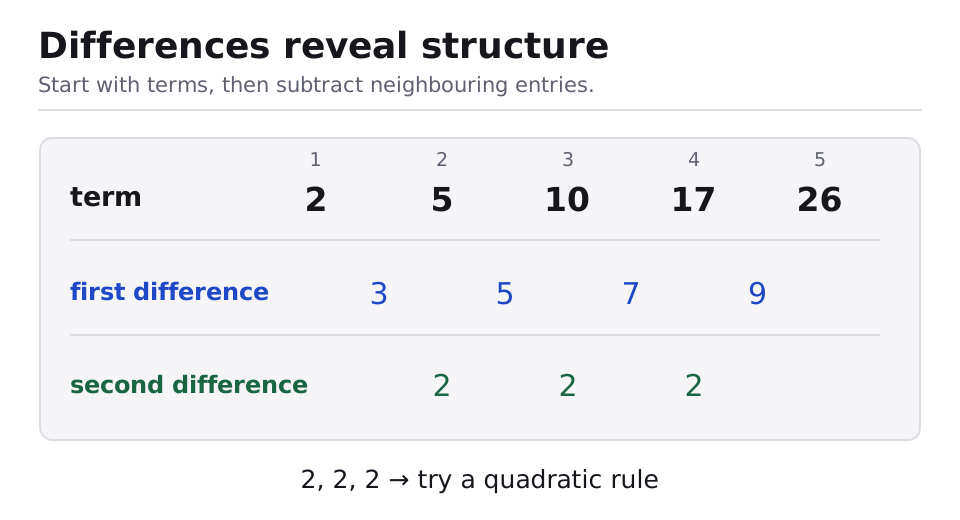
A list of values rarely comes with its formula. Looking at the changes between terms is a useful first move: a fixed first difference suggests a line; a fixed second difference suggests a quadratic; a fixed ratio suggests repeated multiplication. This is useful for pattern questions, tables of measurements, and deciding which model to try.
This is foundational to intermediate work. Review arithmetic and geometric sequences first. OpenStax's sequence lesson gives more practice writing a rule from terms.
A basic idea: make a second row
For , subtract each term from the next. The first differences are . They are not constant, so an arithmetic rule does not fit. Subtract again: the second differences are . A quadratic is a good candidate. Here gives all five listed terms when starts at .
A quick tour of pattern clues
| What stays constant? | Likely simple rule | Example |
|---|---|---|
| First difference | Linear in | |
| Second difference | Quadratic in | |
| Ratio of consecutive nonzero terms | Geometric or exponential |
These tests assume equally spaced positions: term 1, term 2, term 3, and so on. For , the second difference is when the index rises by . So a second difference of suggests ; the first two terms then determine and .
For a ratio, divide each term by its predecessor. The sequence has ratio each time, although its differences are . A changing difference can still come from a very simple multiplier.
A finite list never proves a unique continuation. Many formulas can match its first five terms and differ later. Use the story behind the data, a stated rule, or extra terms to choose a model. Differences and ratios are clues, not a substitute for checking the proposed rule.
Application 1: square tiles with one extra
A pattern uses tiles in designs through . Each design is an by square plus one extra tile. Predict design and explain why.
- Read the structure. Design has square tiles and extra, so .
- Check the list. , , and agree.
- Predict. . The differences predict the same result: the next first difference is , and .
The picture of the design supplies a reason for the formula; the table alone would not.
Application 2: a repeated multiplier
A lab model records units at four equally spaced observations. If the same multiplicative rule continues, what is the next model value?
- Compare ratios. . The differences, , are not constant.
- Write the candidate rule. With observation 1 as the start, .
- Predict and check. . Substituting gives , matching the last known value.
This prediction is conditional on the model continuing; observations could change for reasons the short table does not show.
Resources
| Source | Title | Why read it |
|---|---|---|
| OpenStax | Sequences and their notations | Practise moving from listed terms to a rule. |
Finished this module? Mark it done.
Comments
Stuck on something, spotted a mistake, or found a resource that helped you? Tell us below.
Loading comments