INAIO Guide Stage 1 11Matrices and Linear Transformations
11.4 Systems and transformations
Write simultaneous equations as Ax=b and use matrices to describe how every point is transformed.
In Module 2.2, we solved several linear equations at once. In Module 11.3, each matrix row produced one output from the same inputs. Put those ideas together: a system of equations can be written as one matrix calculation. The same calculation also tells us how a matrix moves every input vector to an output vector. These are two ways to read .
This is intermediate linear algebra. OpenStax's lesson on matrix systems develops solving methods. Review matrix–vector multiplication (Module 11.3) first.
A basic idea: equations as rows, transformations as columns
The system , becomes
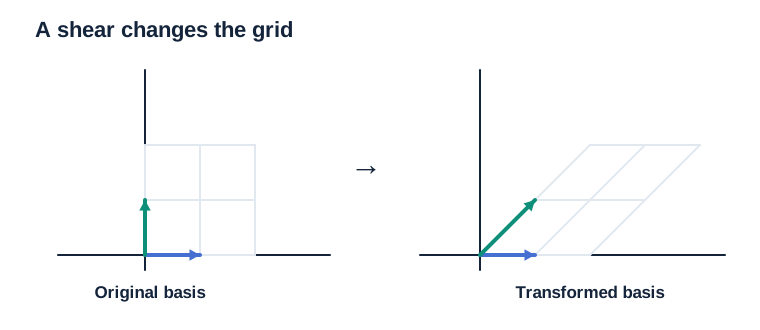
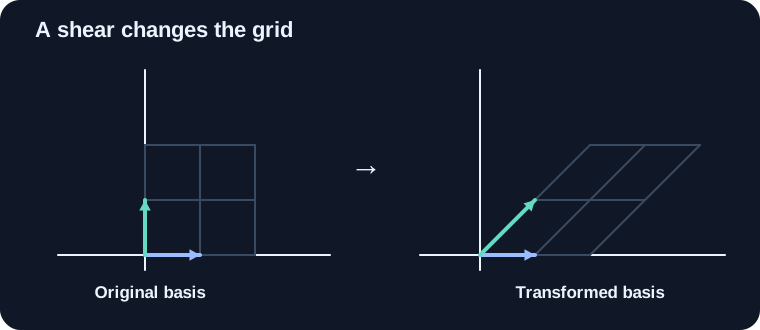
Each row encodes one equation, so writing packages the system from Module 2.2; it does not change its solutions. For the geometric reading, ask what does to a point : is its new position. The first column of is where lands and the second is where lands. These two unit arrows are called the standard basis vectors. Knowing where they land tells us where every point lands, because .
A quick tour of properties
For of shape , has equations and unknowns. A system can have exactly one solution, no solution, or infinitely many. A linear transformation satisfies and ; therefore it always sends the zero vector to zero. An added offset would make the map affine, not linear.
Application 1: solve two equations
Solve and .
- From the second equation, .
- Substitute into the first: , so and .
- Then . Check: .
Application 2: shear a point
Let . Its columns show and . For ,
The basis-vector view and the row calculation agree.
Resources
| Source | Title | Why read it |
|---|---|---|
| OpenStax | Solving systems with Gaussian elimination | Write systems using coefficient matrices and solve them. |
| OpenStax | Matrices and matrix operations | Review matrix products used by transformations. |
Finished this module? Mark it done.
Comments
Stuck on something, spotted a mistake, or found a resource that helped you? Tell us below.
Loading comments