INAIO Guide Stage 1 1Numerical Foundations
1.5 Floor, ceiling and rounding
Distinguish nearest rounding from always rounding down or up, and control when approximations affect an answer.
Many questions start with a continuous quantity but require a whole-number answer: packets, moves, people, or completed rounds. Rounding also appears when a problem asks for a specified number of decimal places. Choosing the wrong operation, or rounding too early, can change an answer by one even when the arithmetic before it is correct.
This is foundational material. Khan Academy's decimal-rounding lesson is a good starting point. Math Is Fun's floor-and-ceiling explanation shows how the two functions behave, including for negative numbers. You need only signed numbers and division to follow this module.
A basic idea: three different answers
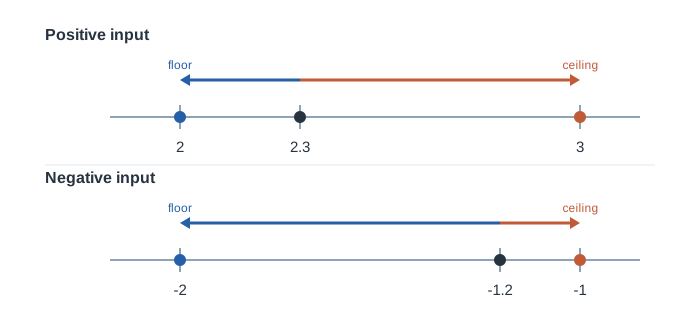
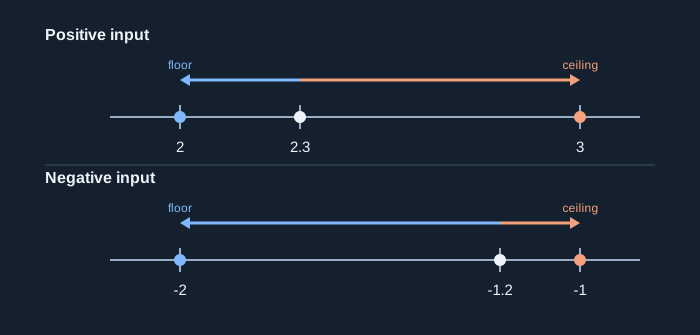
Consider . Rounding to the nearest integer gives . Its floor is also , because is the greatest integer no larger than . Its ceiling is , the smallest integer no smaller than . These operations happen to agree sometimes, but they ask different questions.
For , the floor is and the ceiling is . “Down” means left on the number line, not toward zero.
A quick tour of rules
The definitions are
If is an integer, . Otherwise, . Another useful check is
Floor and ceiling are linked by . For example, .
Rounding to the nearest integer chooses the closer integer instead. If a number falls exactly halfway between two integers, the rule for breaking ties must be stated; different contexts use different conventions. To round to decimal places, look at the next digit. Under ordinary nearest rounding, the numerical error is at most , including a possible halfway tie.
Keep exact fractions or enough decimal places until the final requested operation. In particular, and can change when a rounded approximation crosses an integer boundary.
Application 1: complete and partial packets
A device records samples. Each packet holds samples. How many packets can be filled completely, and how many are needed to send all samples?
- Divide by the capacity. packets.
- Count complete packets with floor. packets hold samples.
- Count every packet needed with ceiling. Five samples remain, so one more packet is needed: .
Nearest rounding would give , but it does not explain the two different questions. “Completely filled” asks for floor; “enough to hold everything” asks for ceiling.
Application 2: a probability near a cutoff
A calculation gives a probability of . The requested answer is . What should you report?
- Keep the given precision. .
- Apply floor at the end. The greatest integer no larger than is .
- Check an early-rounding trap. Rounding to first would give , one too high.
The difference is small before the floor operation but decisive afterward. If an input is already an approximation, check whether its uncertainty is narrow enough to keep the same integer answer.
Resources
| Source | Title | Why read it |
|---|---|---|
| Khan Academy | Rounding decimals | Review place value and rounding on a number line. |
| Math Is Fun | Floor and ceiling functions | See definitions, negative-number examples, and step graphs. |
Finished this module? Mark it done.
Comments
Stuck on something, spotted a mistake, or found a resource that helped you? Tell us below.
Loading comments