INAIO Guide Stage 1 8Probability
8.6 Probability trees
Draw a branch for each stage, multiply along complete paths, and add the separate paths that satisfy an event.
Earlier modules gave us conditional probability for one known event and total probability for combining several routes. A probability tree is a way to organise those routes when an experiment unfolds in stages. Its branches show what can happen next given the path so far. This is especially useful when the second-stage chances change after the first result.
This is foundational to intermediate probability. OpenStax's probability-tree lesson explains branch multiplication, while its outcome-tree lesson helps with listing every path. Module 8.2 introduced a small replacement tree; here we use the tree as a complete calculation method.
A basic idea: every route has its own chance
A bag holds two red balls and one blue ball. Draw twice without replacement. The first draw is red with chance or blue with chance . After red, the bag has one red and one blue, so the second draw has chances and . After blue, both remaining balls are red, so the second draw is red with chance .
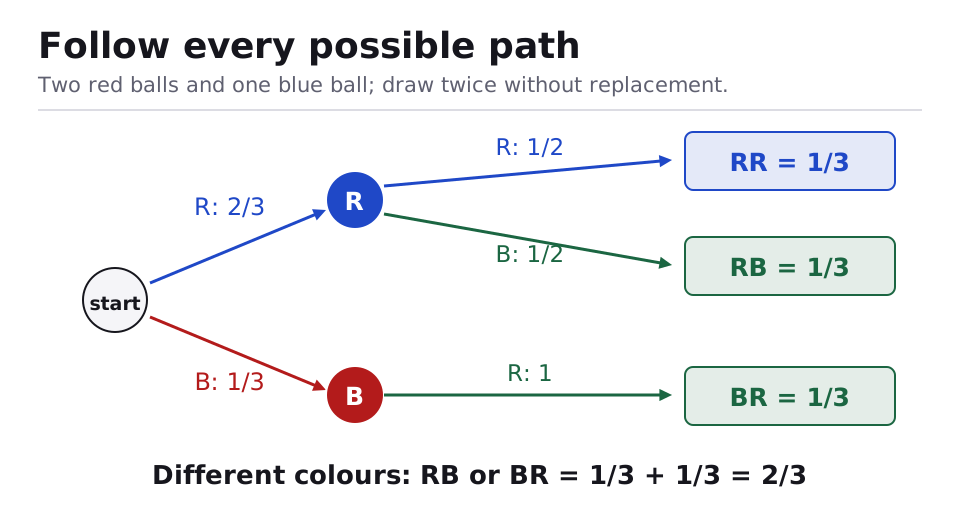
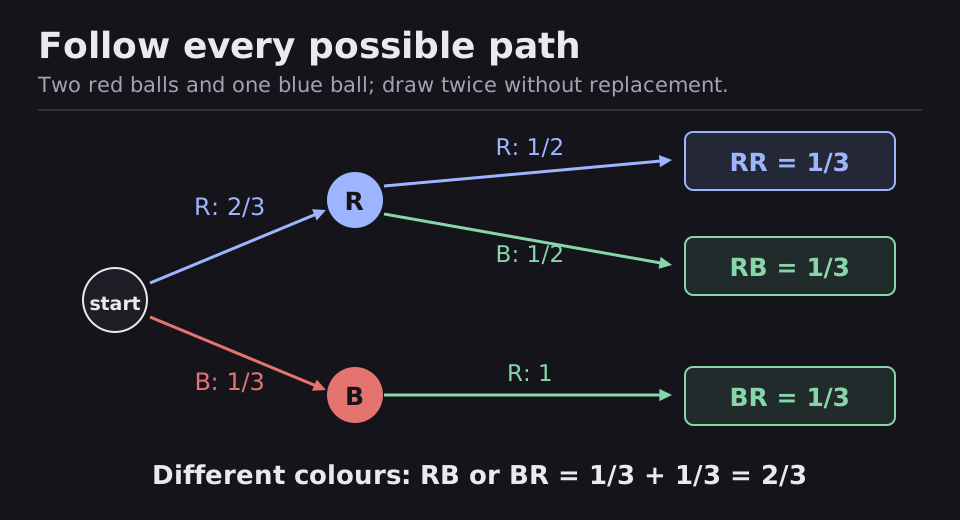
For the path red then blue, multiply . For blue then red, . These paths cannot both occur, so the probability of one ball of each colour is .
A quick tour of tree rules
Start at one root. At each node, draw all possible next outcomes and label their probabilities conditional on reaching that node; the labels leaving one node must add to . Multiply labels along a complete path. Add the probabilities of separate complete paths that satisfy the event. All leaf probabilities together must total if the tree is complete.
For two stages, . The branch after carries , not necessarily the original . If the stage results are independent, that conditional chance stays the same. A tree can also be read backwards: to find the chance of a first-stage cause given a final result, divide the matching path total by the total probability of that result, as in Bayes' theorem.
Application 1: two draws without replacement
From a bag with two red balls and one blue ball, what is the chance that two draws without replacement have different colours?
- The red-then-blue path has probability .
- The blue-then-red path has probability .
- Add the disjoint paths: . The remaining path, red then red, has probability , so the leaves total .
Application 2: a coin chosen by a die
Roll a fair die. If it is even, use a coin with head probability ; if odd, use a coin with head probability . Find the probability of a head and the chance the die was even given a head.
- Even and odd each have probability . The even-then-head path is ; odd-then-head is .
- Add them: .
- Among head outcomes, the even path supplies of the total , so .
Resources
| Source | Title | Why read it |
|---|---|---|
| OpenStax | Tree and Venn diagrams | Follow conditional branches in multistage experiments. |
| OpenStax | Tree diagrams, tables, and outcomes | Begin by listing paths before adding probabilities. |
Finished this module? Mark it done.
Comments
Stuck on something, spotted a mistake, or found a resource that helped you? Tell us below.
Loading comments